
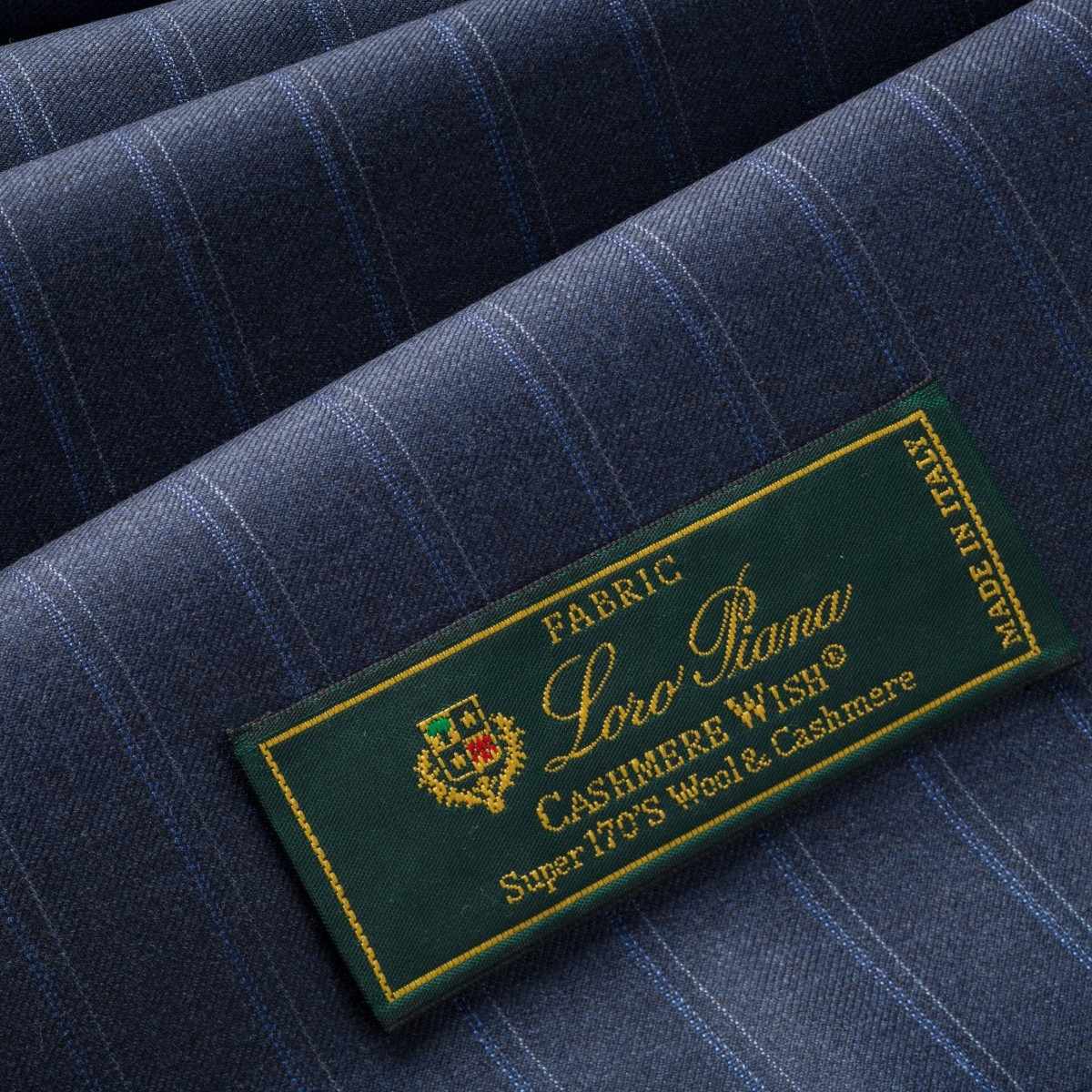
What is the difference between fibre and weave?
The fibre is the raw material: wool, cashmere, linen, cotton, silk. The weave is the way the threads cross on the loom: twill, herringbone, plain weave. The same wool can become a smooth, crisp twill or a soft, matt flannel. To choose a cloth, then, you have to look at both.
Which fibres for a bespoke suit?
Wool
Wool remains the fibre of the suit. It most often comes from the merino sheep. It breathes, regulates warmth, recovers its shape after wearing and creases little. It is found pure or blended with other fibres, natural ones such as silk or linen, or synthetic ones.
The label Super 100s, 130s or 150s indicates the fineness of the fibre: the higher the number, the finer, softer and lighter it is, and the more delicate. A Super 150s corresponds to a fibre of about 16 microns.
Noble fibres
- Cashmerecomes from the down of the goat of the same name, raised in the cold regions of Central Asia. Very soft and warm, it is worn pure in a jacket or a coat, or blended with wool.
- Mohaircomes from the Angora goat. Its lustrous, springy fibre makes summer suits that barely crease.
- Alpacais the fleece of an Andean camelid, warmer and lighter than wool.
- Vicuña, a small wild camelid of the high Andean plateaux, yields a fibre of about 12 microns, among the finest known, gathered in very small quantities.
- Camel hair, from the Bactrian camel, is warm, light and strong: a fibre for coats.
- Silkis rarely worn alone in a suit. Blended with wool or linen, it adds lustre and body.
Linen and cotton
Linen, drawn from the stems of the plant, is cool and light. Its failing is well known: it creases almost at once. Cotton, supple and breathable, brings a more relaxed note to the warmer months; it does, however, show stains and creases.
Synthetic fibres
Polyester and viscose cost less and crease less. But they lose what gives natural fibres their worth: breathability and the regulation of warmth. A small proportion blended with wool can, however, make a pair of travelling trousers more resilient.
What are the most common weaves for plain cloths?
Twill
The weave of the classic suit. You recognise it by its fine, regular diagonals. Crisp and hard-wearing, it can be worn in any season, depending on its weight, day or evening.
Gabardine
A very tightly woven twill, with clearly marked diagonal ribs and a smooth reverse. It resists wear and hangs cleanly: a cloth for trousers.
End-on-end
Alternate a light thread with a dark one, and the result is a near-plain with a fine, flecked texture. Less formal than a plain twill, it is worn mostly in the daytime.
Caviar, or bird's eye
A scattering of tiny, close-set dots that, from a distance, merge into a single nuanced shade. Often grey, it deserves to be rediscovered in blue or brown. A discreet plain, and a fairly formal one.
Herringbone
A twill whose diagonal changes direction at regular intervals, tracing rows of chevrons. Even in a single colour, it plays with the light. It can be worn in any season.
Flannel
More a finish than a weave: a carded wool, lightly brushed, very soft to the touch and matt to the eye. It is the cloth of autumn and winter, for suits and trousers alike.
Tweed
A fairly rustic carded wool, woven from yarns of several colours. Robust and little troubled by rain, it makes jackets for autumn and winter.
Which patterns, and for what occasion?
- Pinstripesfine light lines on a dark ground. Formal, they are worn mostly in the daytime.
- Chalk stripesmore widely spaced, with a soft-edged line, as if drawn in chalk, often on flannel.
- Double stripestwo lines set very close together, a more modern take on the pinstripe.
- Prince of Wales checksmall checks laid over larger ones. It descends from the Glen Urquhart check of 19th-century Scotland. Classic, but sportier: best by day.
- Windowpane checklarge checks in a fine line, drawn like the glazing bars of a window. Readily worn as an odd jacket.
- Gun club checktwo-colour checks on a light ground, said to take their name from an American shooting club of the late 19th century. A cloth for jackets.
- Houndstootha pattern of small jagged teeth recalling the print of a paw; on a larger scale, it is sometimes called dogtooth. Rather sporty.
- Tartanthe multicoloured checks of Scotland, for a jacket or trousers, in winter.
- Hairline stripesvery fine, close-set stripes that read as a near-plain from a distance. Fairly formal.
- Seersuckera puckered cotton of Indian origin, whose name comes from the Persian for “milk and sugar”. The cloth of summer jackets.
- Corduroya cotton with vertical ribs, broad or fine, for a winter jacket or trousers.
How do you choose a cloth for the season?
The weight of a cloth is expressed in grams per metre. As a guide, allow about 230 to 260 grams for summer, 260 to 300 for the in-between seasons, and over 300 for winter. The weave matters as much as the weight: an open weave such as fresco lets the air through; a flannel holds it in.
If you are to own only one suit, choose a mid-weight twill in navy or grey.
Where can you see and handle these cloths?
At the boutique on avenue Hoche, I work with 13,000 cloths, arranged in four ranges: Découverte, Maison, Privilège and Signature. Among the houses represented are Ermenegildo Zegna, Vitale Barberis Canonico, Drago, Holland & Sherry and Dormeuil. For a first glimpse, browse the house's cloth ranges, then see how they translate into a bespoke suit.
A cloth is chosen by hand, and by daylight. Book a private consultation, at the atelier or by video call: I will bring out the swatch books suited to the use you have in mind.