What is the canvas in a jacket?
The canvas is the intermediate layer set between the outer cloth and the lining, at the front of the jacket. It is also known as the interlining. It gives the chest its structure, the lapel its curve and the shoulders their line: three areas put to work with every movement.
Without it, a wool jacket would fall flat, like a shirt. With it, the jacket keeps a shape of its own, even on a hanger. The whole question is how this canvas is attached to the cloth: bonded with heat, or sewn. From that choice follow three broad families of construction.
How is a fused jacket constructed?
In a fused jacket, the canvas is coated with an adhesive that sets under heat and pressure. It then becomes one with the reverse of the cloth, across the whole front.
Its strengths
The process is quick and reduces the number of operations done by hand: the canvas is glued rather than sewn. It is the most widespread construction in ready-to-wear, from the entry level up to some very expensive labels. It makes sense for a first suit, a piece worn occasionally or a modest budget.
Its limitations
Bonded to the canvas, the cloth loses some of its fluidity. The jacket can feel stiff, especially if you are used to soft cloths that follow the body. A fused surface also lets less air through. In the past, the front would sometimes bubble after cleaning or in high humidity. Today's adhesives and presses have made this flaw rare, without eliminating it altogether.
What is a half-canvassed jacket?
A half-canvassed jacket, also called a half canvas, carries a sewn canvas over the upper half of the front: the chest and the lapel. The lower front is usually reinforced with a lighter, fused canvas.
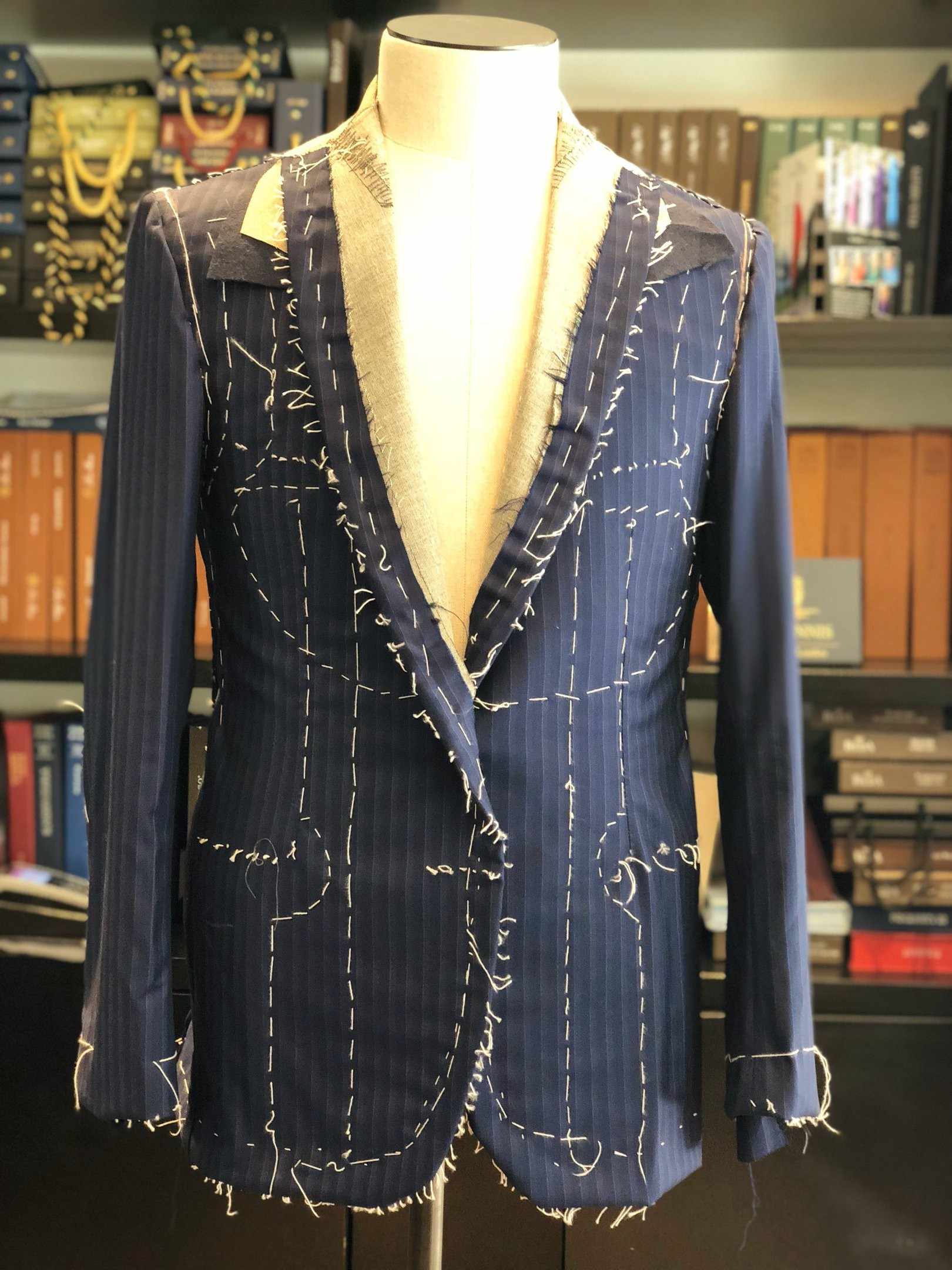
This canvas is not glued to the cloth. It is basted to the reverse with stitches that remain invisible from the right side. It is said to “float”: it moves with the cloth instead of setting it rigid. In the lapel, dozens of tiny stitches bind the canvas to the cloth and impart a curve. That is what gives the lapel its soft roll, where a fused lapel tends to fold flat.
What is a tailor's canvas made of?
A tailor's canvas usually combines several fibres: wool, linen or cotton, goat hair, and horsehair, which gives it its spring. This chest piece gradually moulds itself to the wearer's torso. A canvassed jacket thus acquires its own patina over time.
Who is it for?
Half canvas already makes a real difference in drape and comfort compared with a fused jacket. It remains lighter than a full construction, which many look for in summer cloths or unstructured jackets.
What is a full-canvas jacket?
In a full-canvas jacket, the floating canvas covers the entire front, from the shoulder to the hem. It is the tailor's traditional construction.
- The drape is cleaner.The jacket gains a little weight and hangs true, without hollowing at the waist.
- It lasts.The strain is spread over the full length of the front, which spares the cloth over the years.
- It breathes.An unbonded canvas lets air circulate better than a fused surface, which helps regulate warmth.
It does, however, take more hours of work, and is priced accordingly. It is also a matter of taste: some like it on fine cloths, to which it lends a little body; others prefer the lightness of a half canvas.
How can you tell how a jacket is canvassed?
The simplest check is the pinch test. Gently pinch the front of the jacket, just below the top buttonhole, and slide the layers between your fingers.
- If you feel three distinct layers, cloth, canvas and lining, the canvas is floating at that point.
- If the cloth and the canvas seem to be one, the jacket is fused.
Repeat the test lower down, at pocket level: you will know whether the canvas runs down to the hem or stops at the chest. Look at the lapel in profile, too. A sewn lapel forms a soft curve towards the buttonhole; a fused lapel stays flatter. Finally, a fused jacket that has suffered at the cleaner's may show slight ripples across the front.
What should you bear in mind before choosing?
The canvas is only one part of the equation. Fine construction cannot make up for approximate measurements, nor for a cloth ill-suited to its purpose. The drape of a jacket depends as much on its cut, its fit and the weight of the cloth as on its canvas. So ask three questions rather than one: how is the jacket constructed, how is it cut for you, and in what cloth.
And at L'Atelier Hoche, how is construction described?
At the atelier, construction is stated simply: our Découverte collection is half-canvassed, and all the others are fully canvassed. To this I add the share of handwork, expressed as a percentage of the work: 20% for Découverte, 30% for Mesure, 50% for Premium and 80% for Fait main, that is, 80% of the work done by hand. From Découverte upwards, the sleeves are set by hand; from Premium, the collar and shoulders are too.
This yardstick tells you what you are buying, without jargon. It sits alongside the choices that matter just as much to the result: more than thirty measurements taken, a pattern in your name, kept and updated with every piece, and two to three fittings. Every piece is fitted in Paris, at the atelier, pin in hand.
To compare the levels and their prices, see the house's bespoke suit. To choose the cloth to go with it, browse the four cloth ranges. And if you would rather feel the difference between two jackets than read about it, book a private consultation, at the atelier or by video call: the first appointment is complimentary.