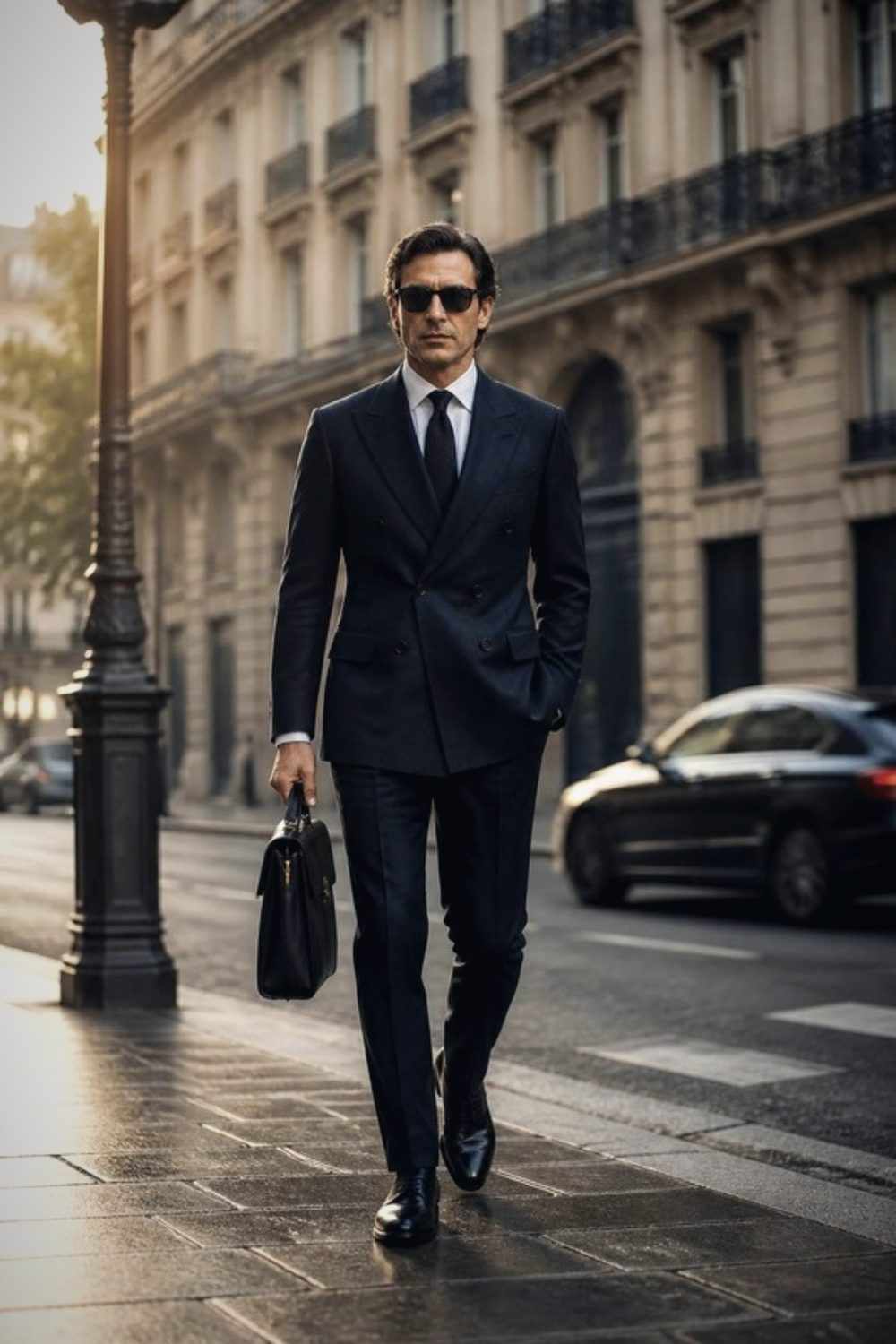
The suit, excellence cut for you.
Bespoke suits for men, avenue Hoche, Paris 8th.
A suit says who you are before you have said a word. Perfectly fitted, it reveals you. English or Neapolitan, classic or bold, two pieces or three: I take your measurements, draw your pattern and carry out every fitting, in a cloth we choose together from thirteen thousand. The details belong to you alone.
01 · Suits
Why choose a bespoke suit?
Because it follows your lines, and yours alone. The shoulder sits exactly where it should, the collar hugs the back of the neck, the jacket stays in place when you raise your arm, the trousers break just once on the shoe: you no longer think about your suit; you wear it.
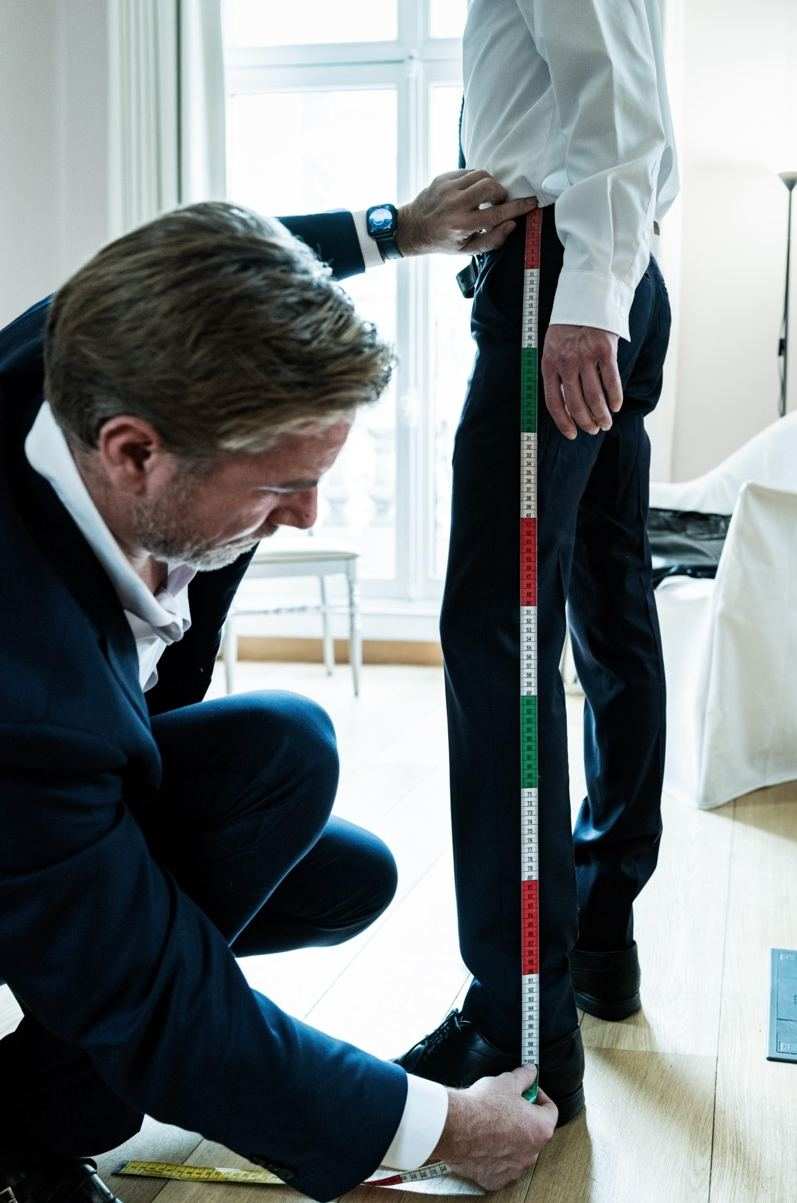
I look at you before I measure you. More than thirty measurements, your posture, the way you move: from these comes a pattern in your name, which I keep and refine with every piece. Your second suit begins with everything the first one taught me.
02 · Suits
Which style of suit is yours?
Before the cloth comes a line: the house's own, then five great schools of cut, which I adapt to your build and to the way you live.
-
The house style
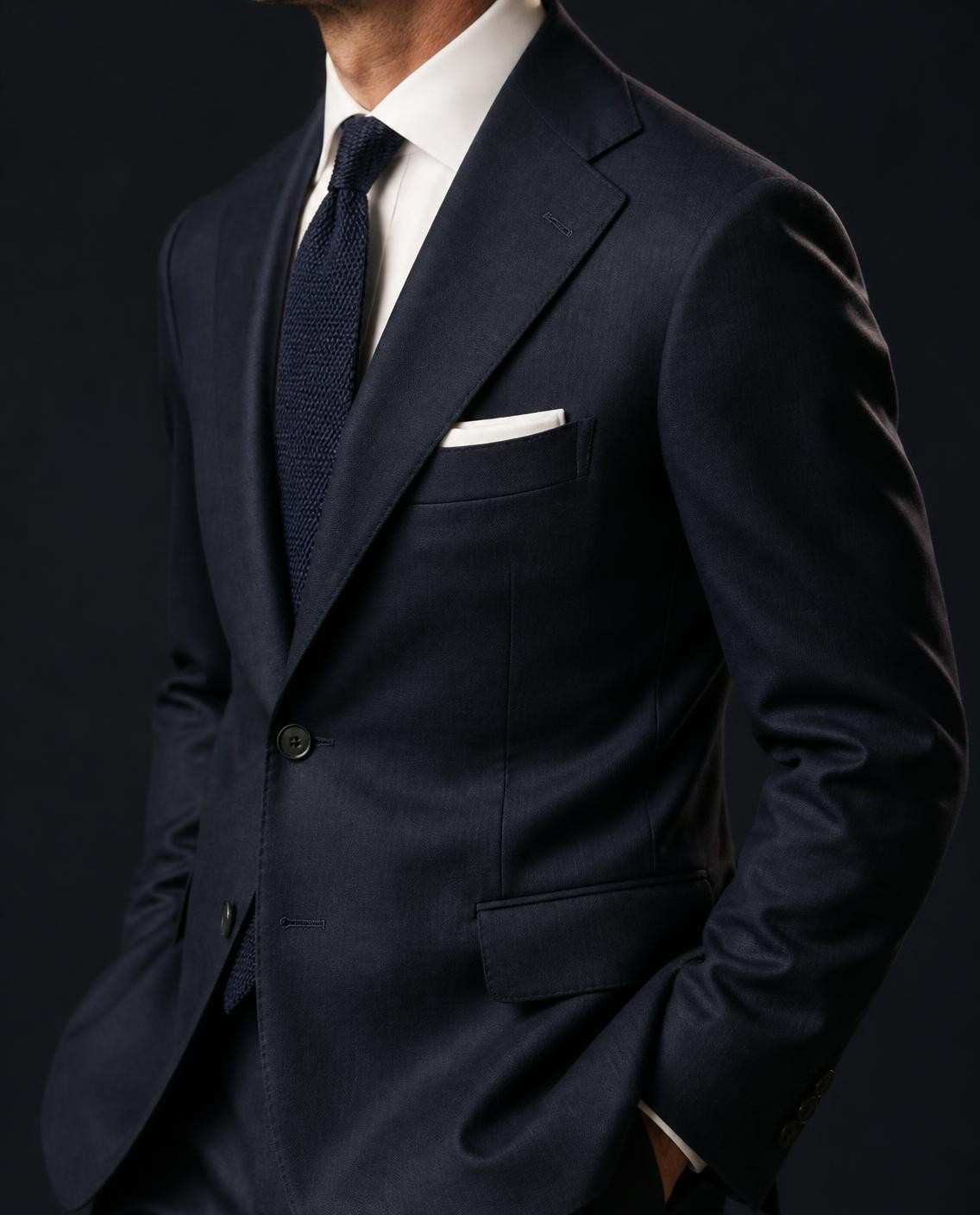
The balance between English structure and Italian suppleness: a fitted cut, with ease allowed for a full day, the Milanese buttonhole on the lapel.
The man who wants to be impeccable at 9 am and at ease at 11 pm.
-
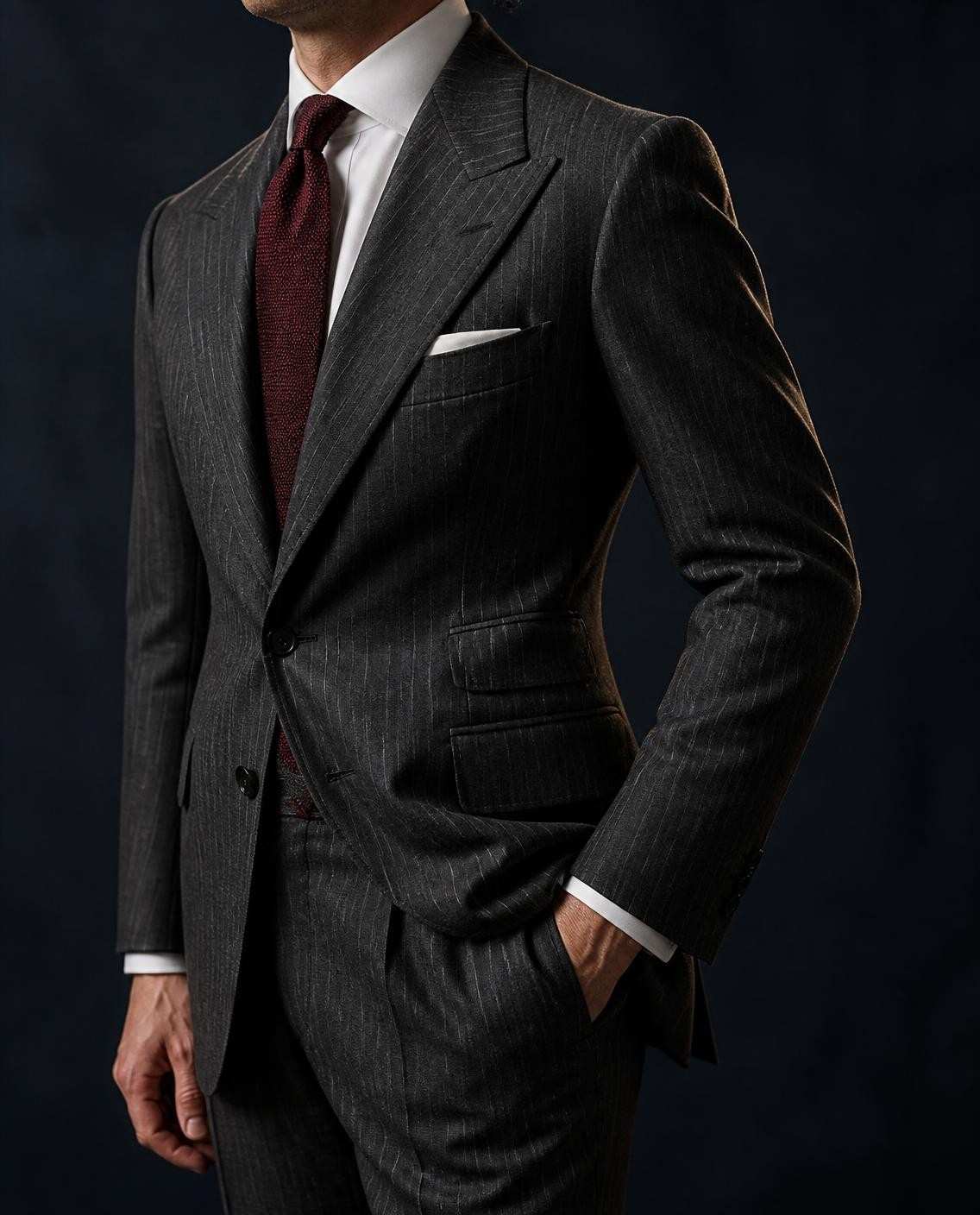
The English
A built-up, clean shoulder, a defined waist, side vents, a ticket pocket, cloths with a dense hand.
The man of counsel, of banking, of tradition: authority through structure.
-
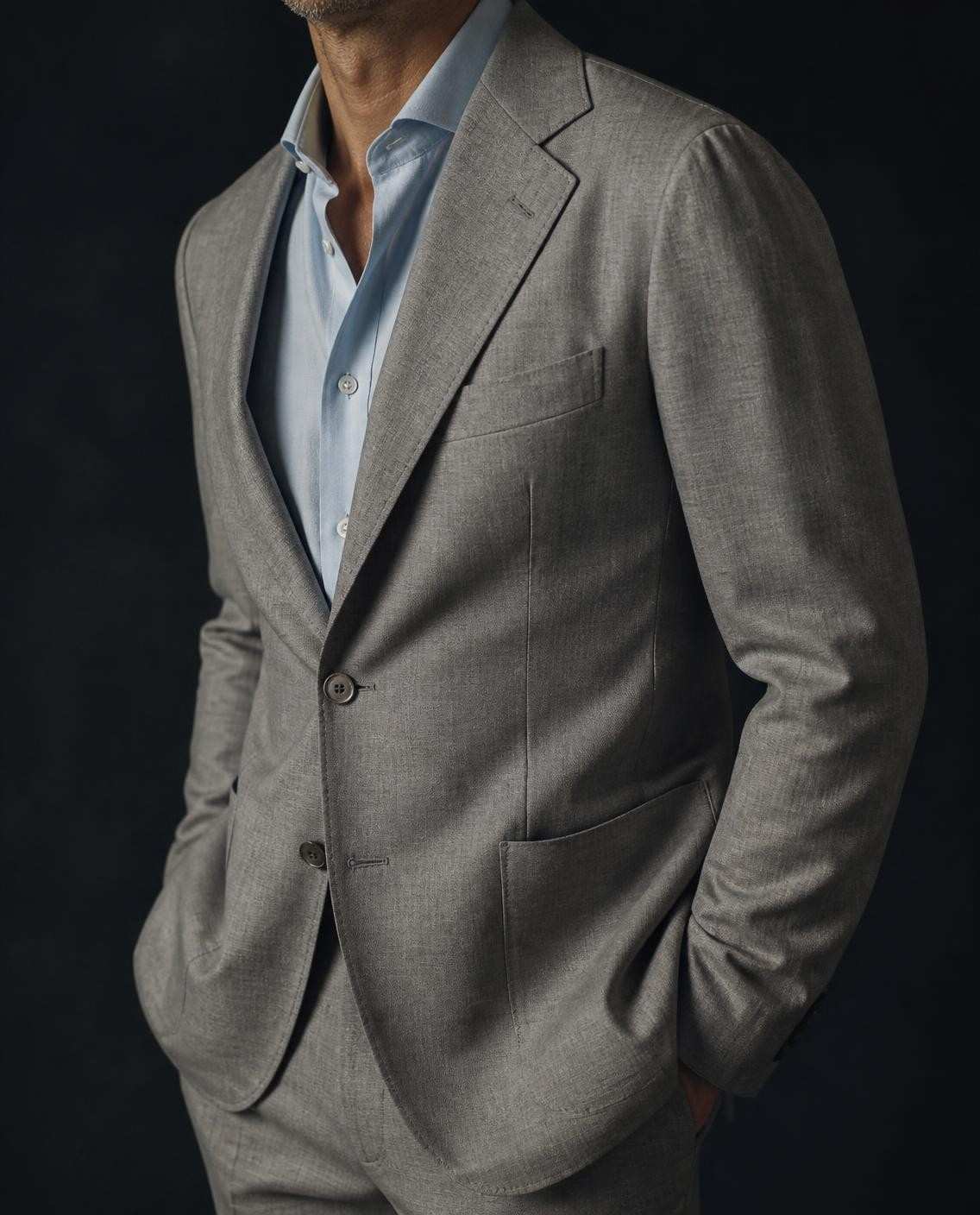
The Italian
A natural shoulder, sometimes a shirt shoulder, a light and supple jacket, fuller lapels, three buttons rolled to two.
The man who wants elegance without stiffness, from Milan to Naples.
-
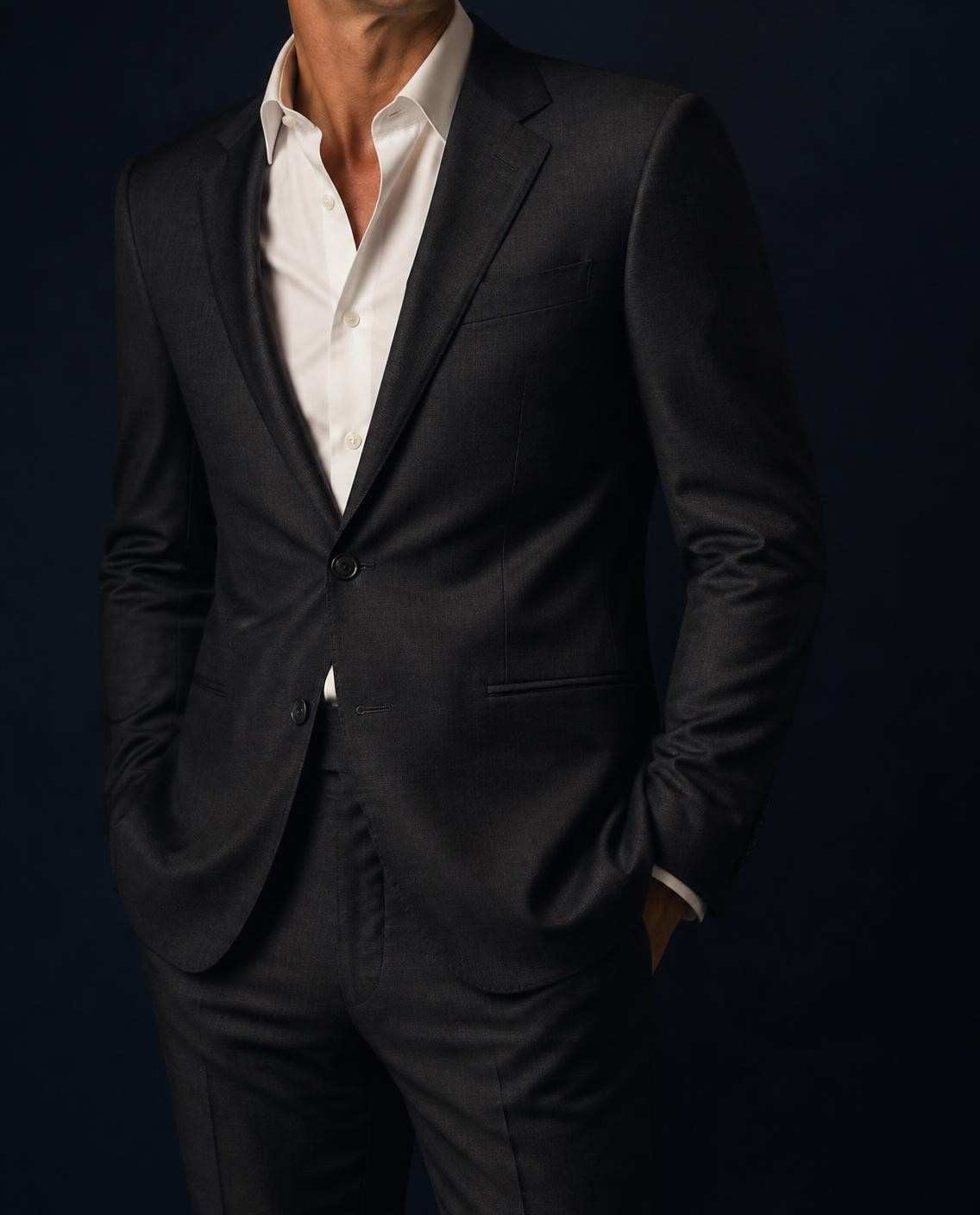
The modern
Cut close to the body, slimmer lapels, a shorter jacket, trousers without turn-ups that just graze the shoe.
Entrepreneurs, the new generation in business.
-
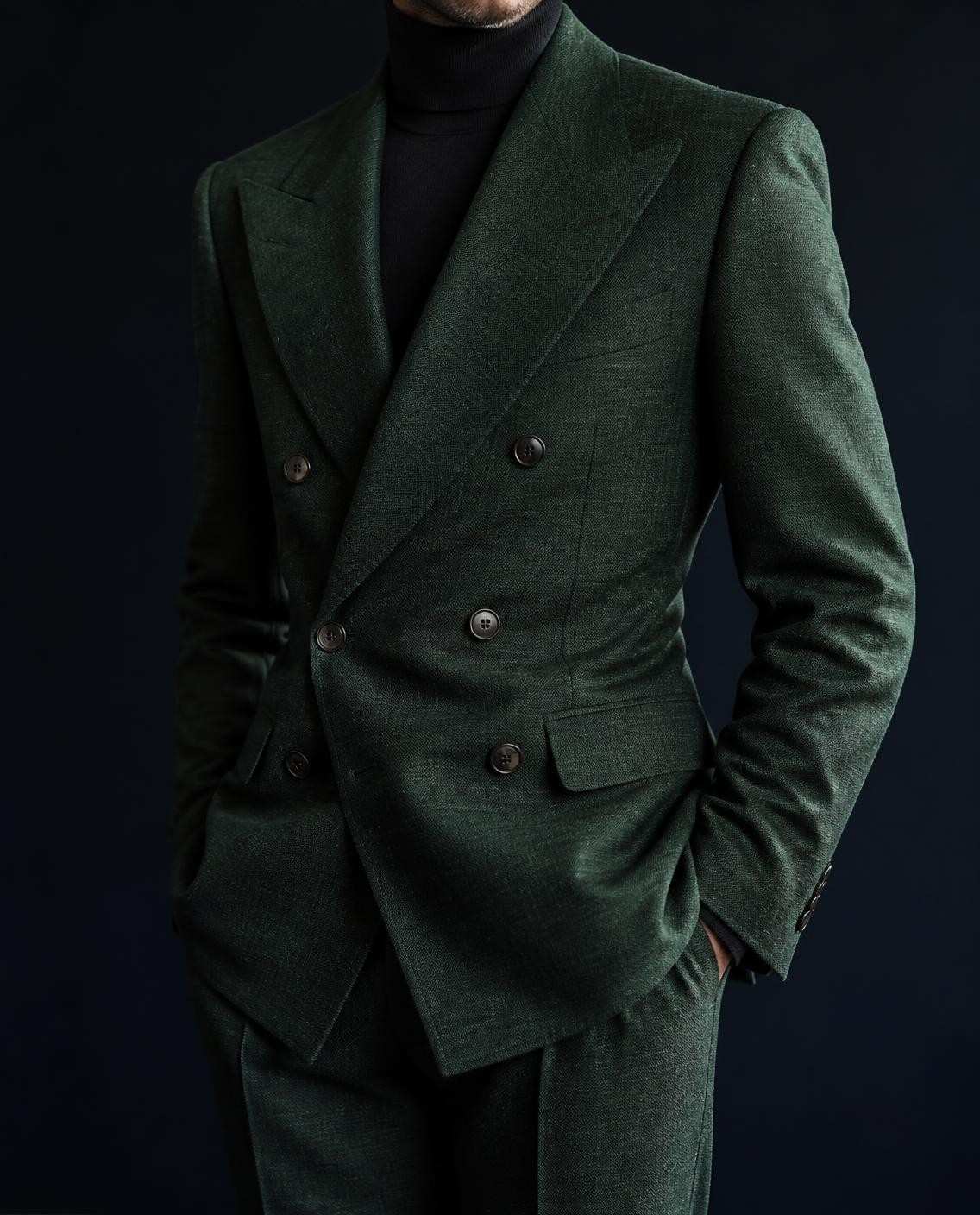
The statement
Six-button double-breasted, broad peak lapels, textured cloths or bold colours, pleated high-waisted trousers.
The man who wants his suit noticed as much as he is.
-
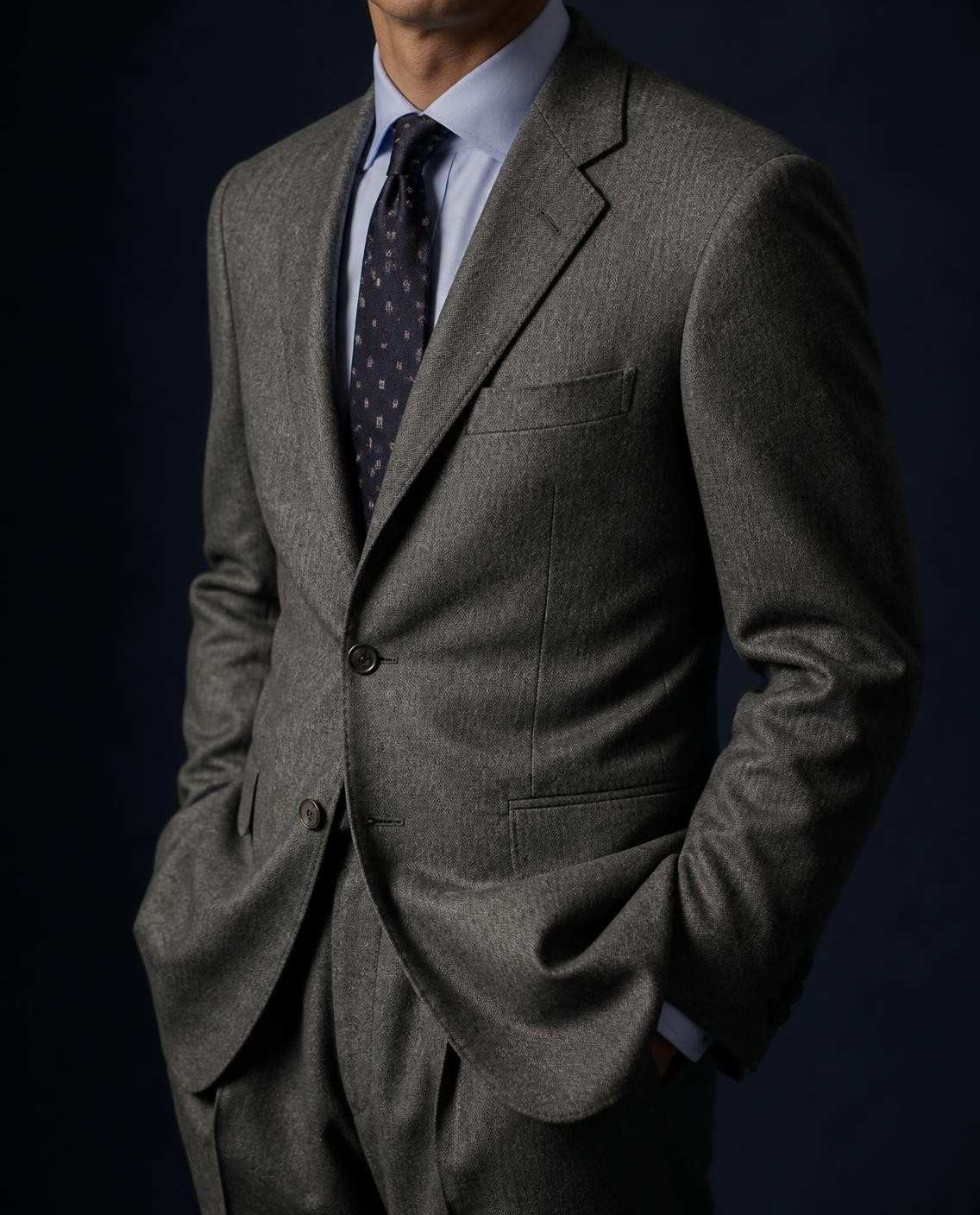
The classic
Two-button single-breasted, notch lapels, pleated trousers, proven lines.
The suit that never dates, from the meeting room to dinner.
And these schools mix: a Neapolitan shoulder on an English waist, a modern double-breasted in a classic flannel. I combine them with you, swatch books in hand, before the first cut.
03 · The models
Two-piece, three-piece, double-breasted: which model to choose?
The model decides when you will wear it; the school of cut, how you will carry it. Each one is drawn on your pattern.
-
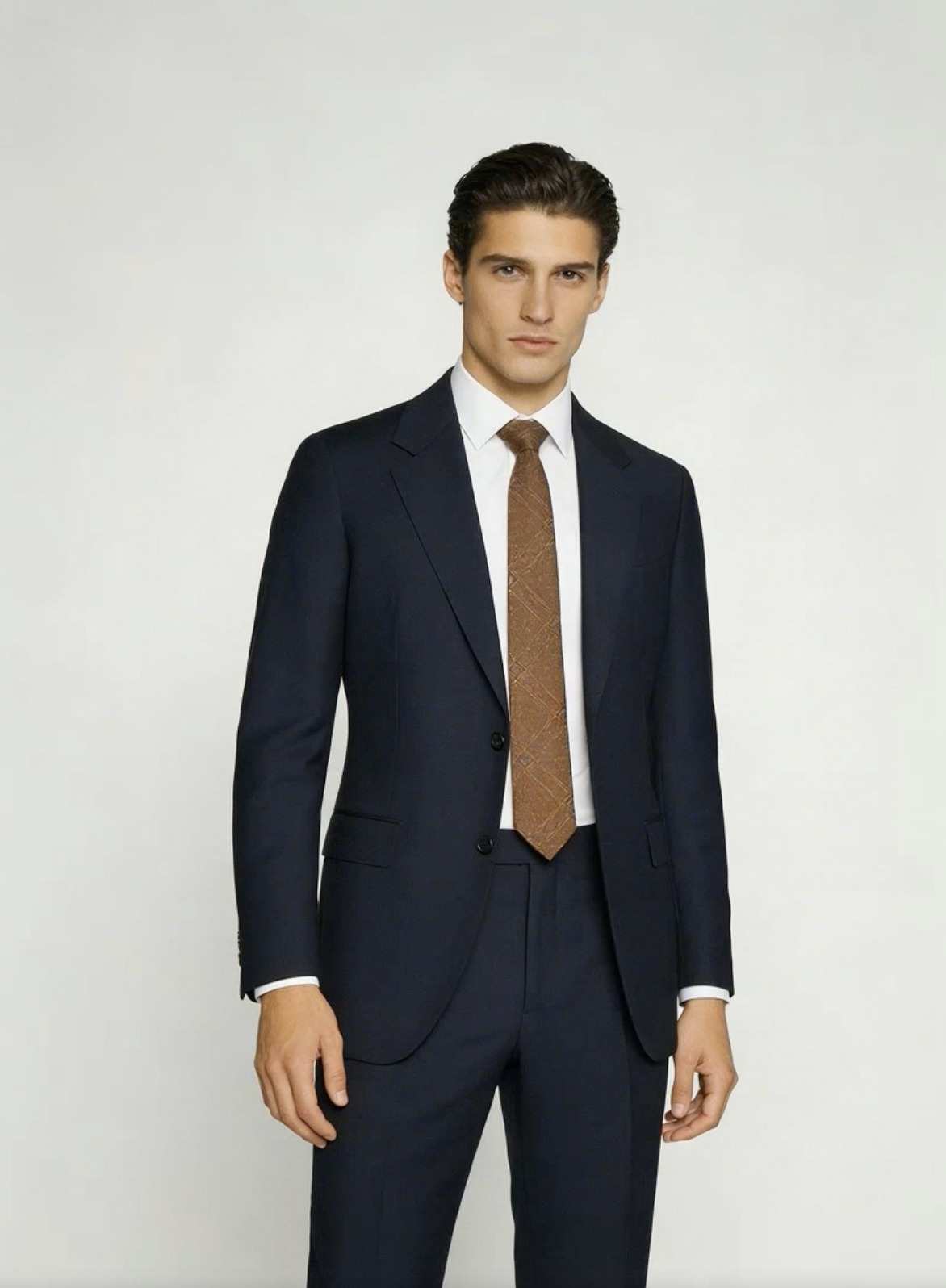
The two-piece
The foundation of every wardrobe: jacket and trousers in the same cloth, from the first meeting of the week to its last dinner.
-
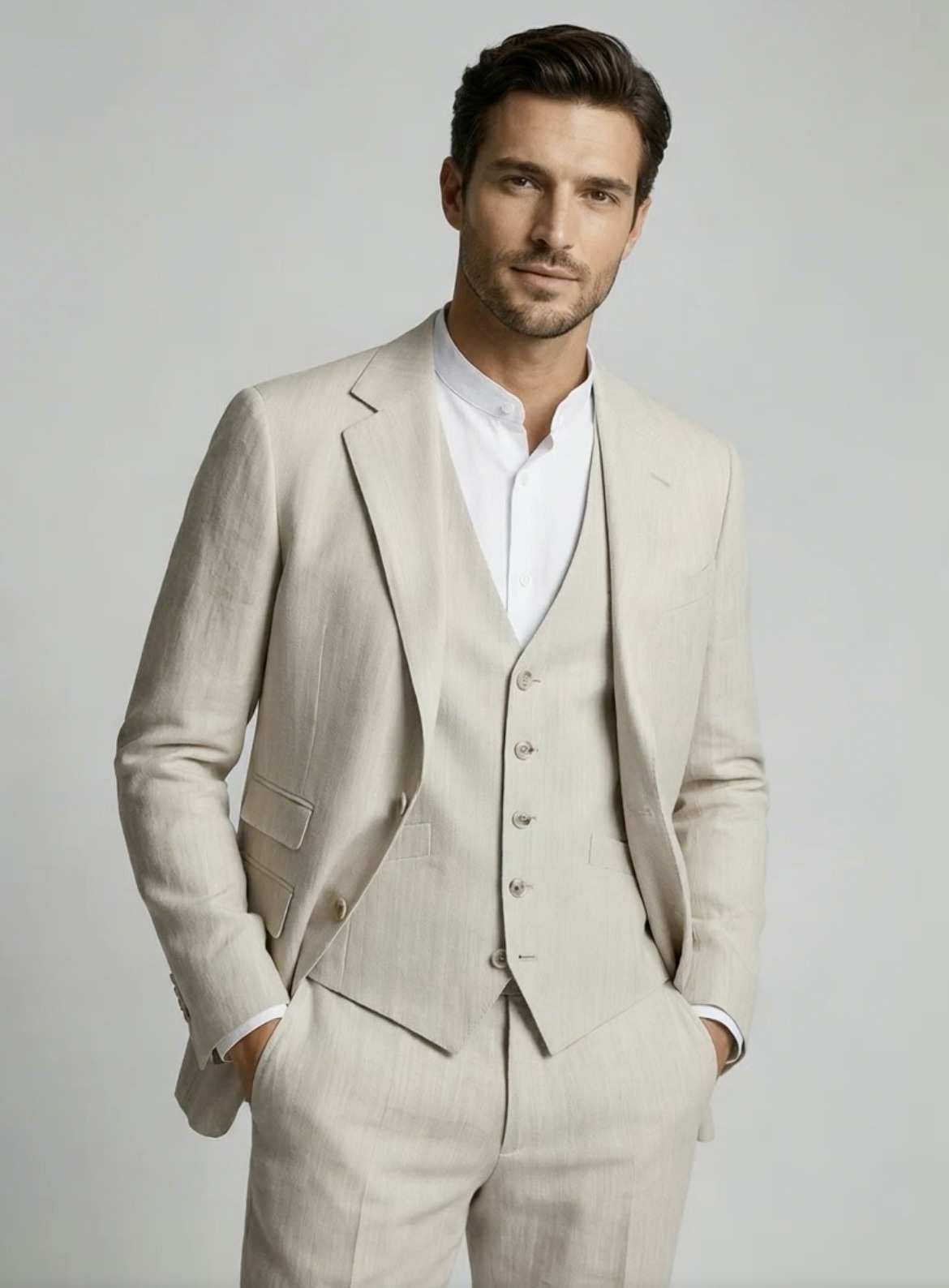
The three-piece
From the boardroom to the ceremony: the waistcoat holds the line when the jacket is open, and adds a note of formality.
-
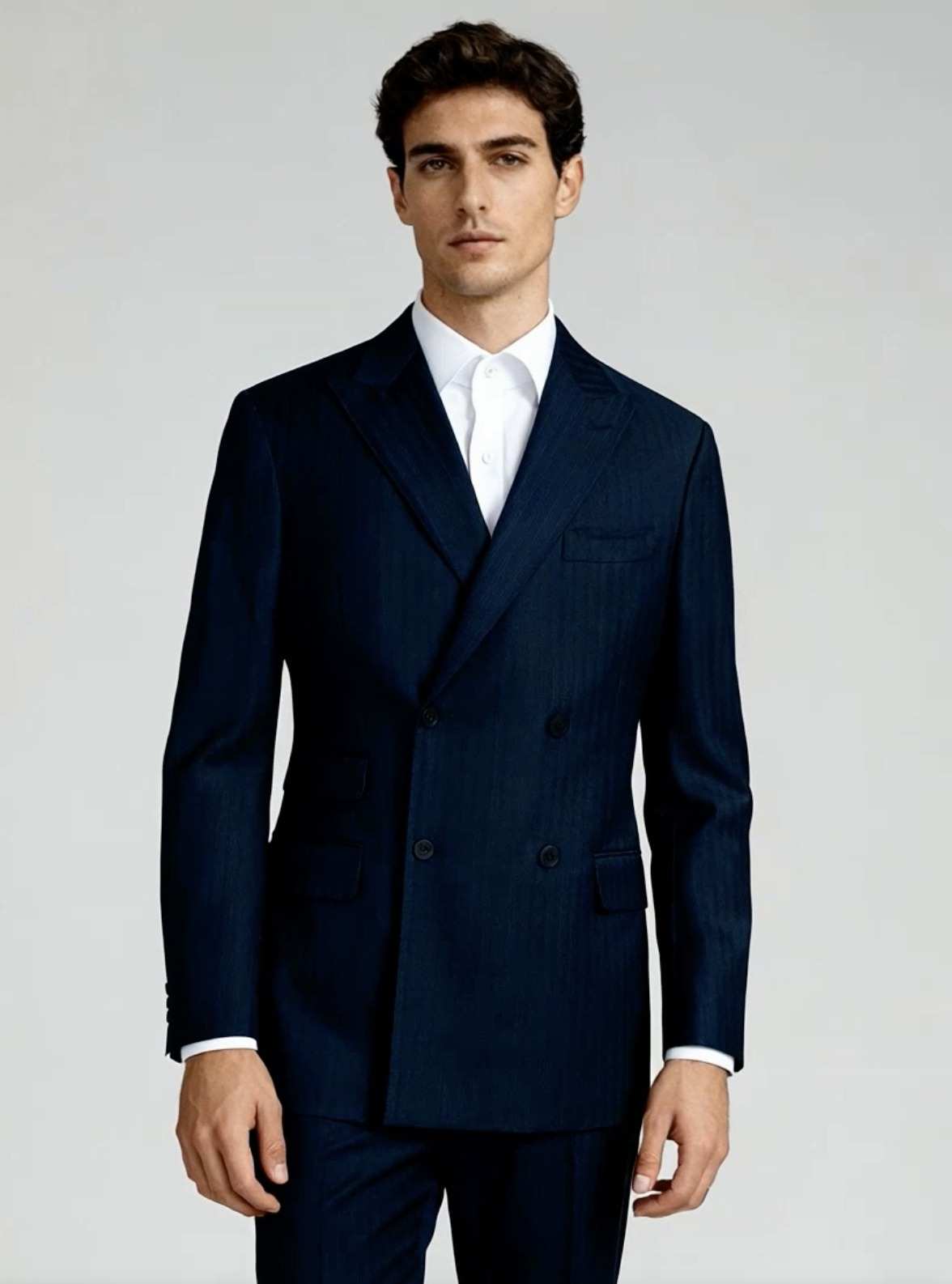
The double-breasted
For a confident bearing: peak lapels, a double row of buttons, a jacket worn closed that defines the shoulders.
-
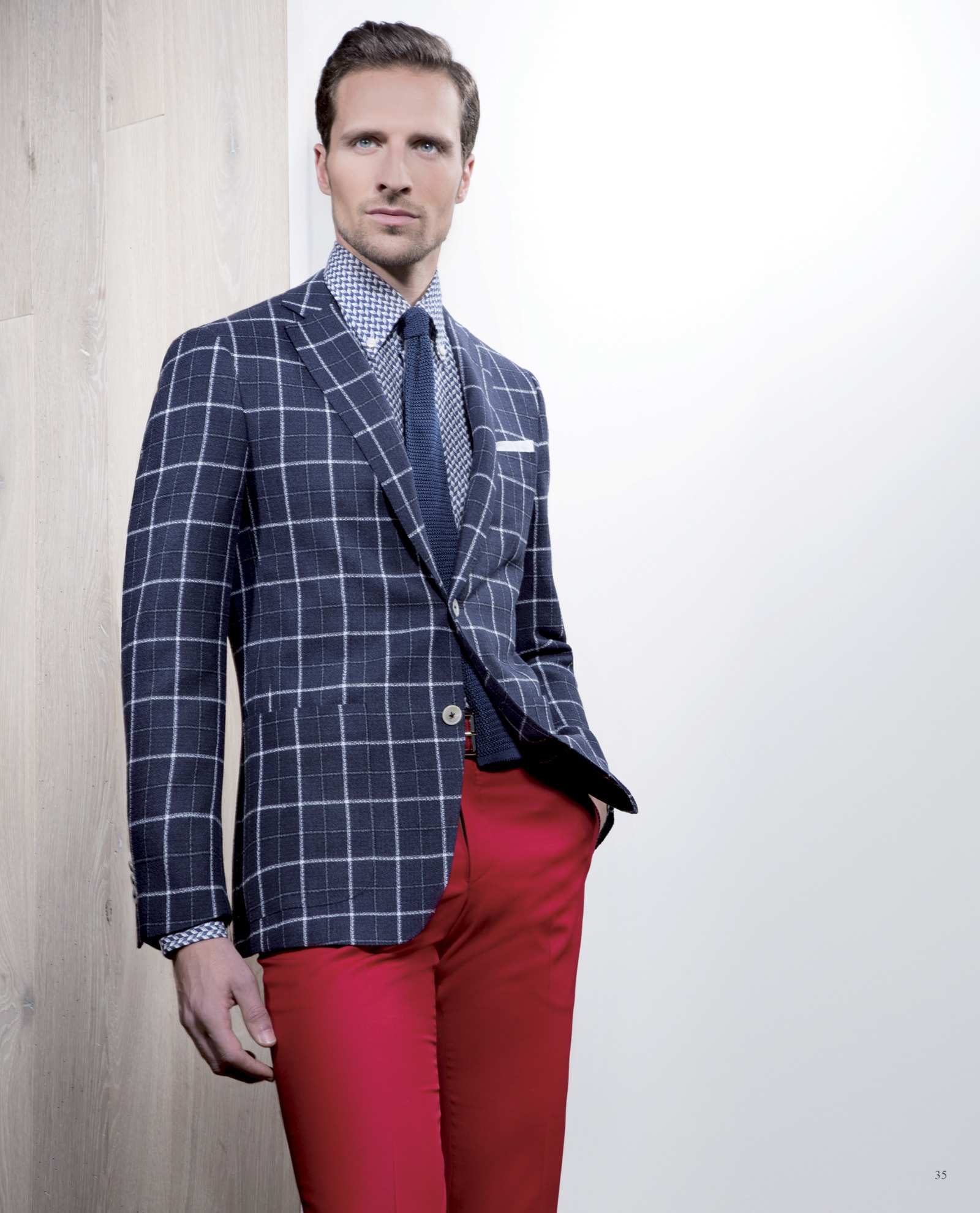
The separates
Jacket and trousers in two cloths that answer each other: a navy blazer over grey flannels, a check against a plain.
-
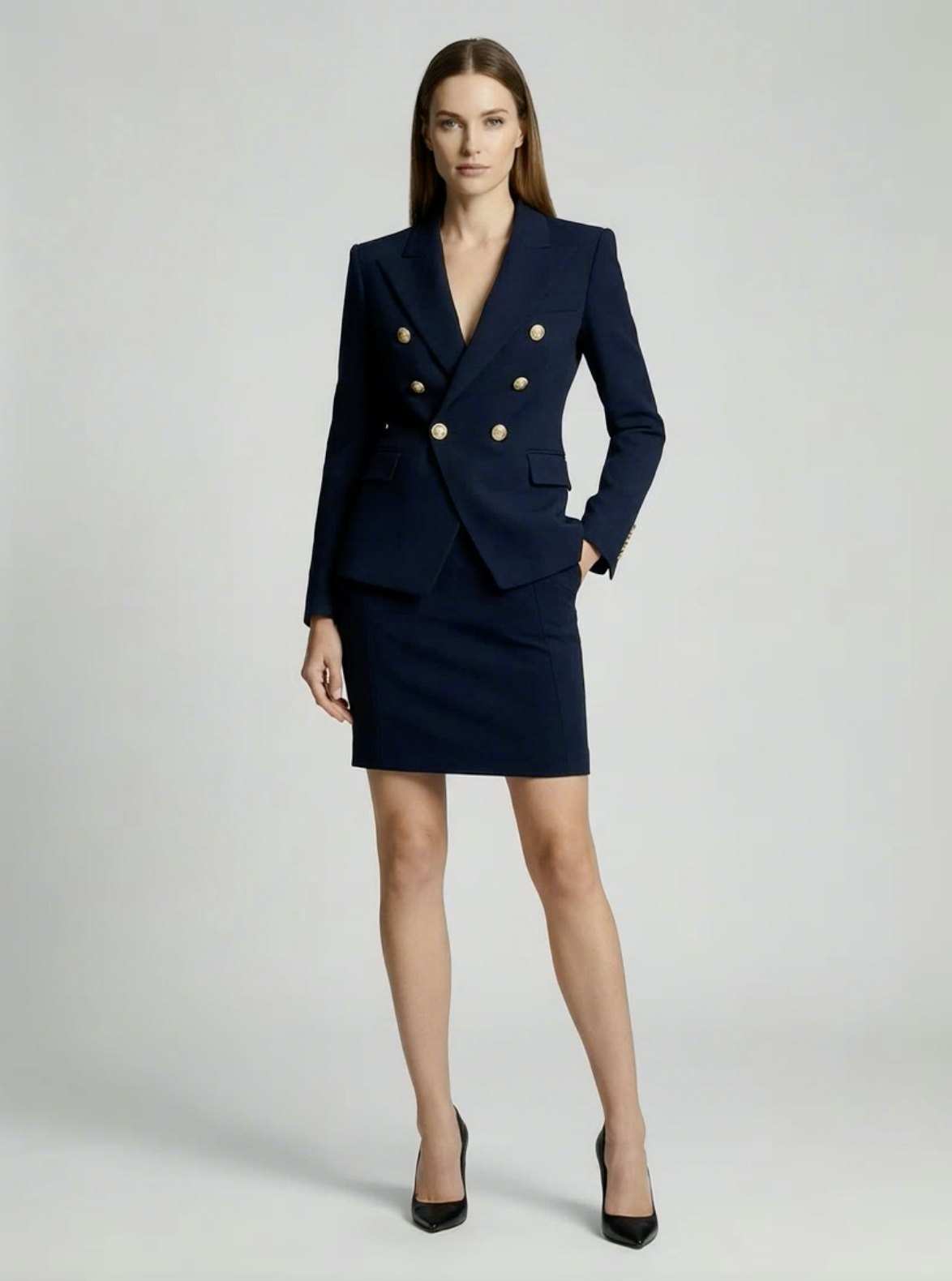
The suit, for her
The same standards, for women: a trouser suit or a skirt suit; see bespoke tailoring for women.
04 · Suits
The anatomy of a suit: what each detail changes
A bespoke suit gives itself away in what can be seen only at twenty centimetres. Every detail is decided with you, and each has its reason; all of them can be seen here in photographs, with a touch on the gold dot. Your own creativity is the only limit.
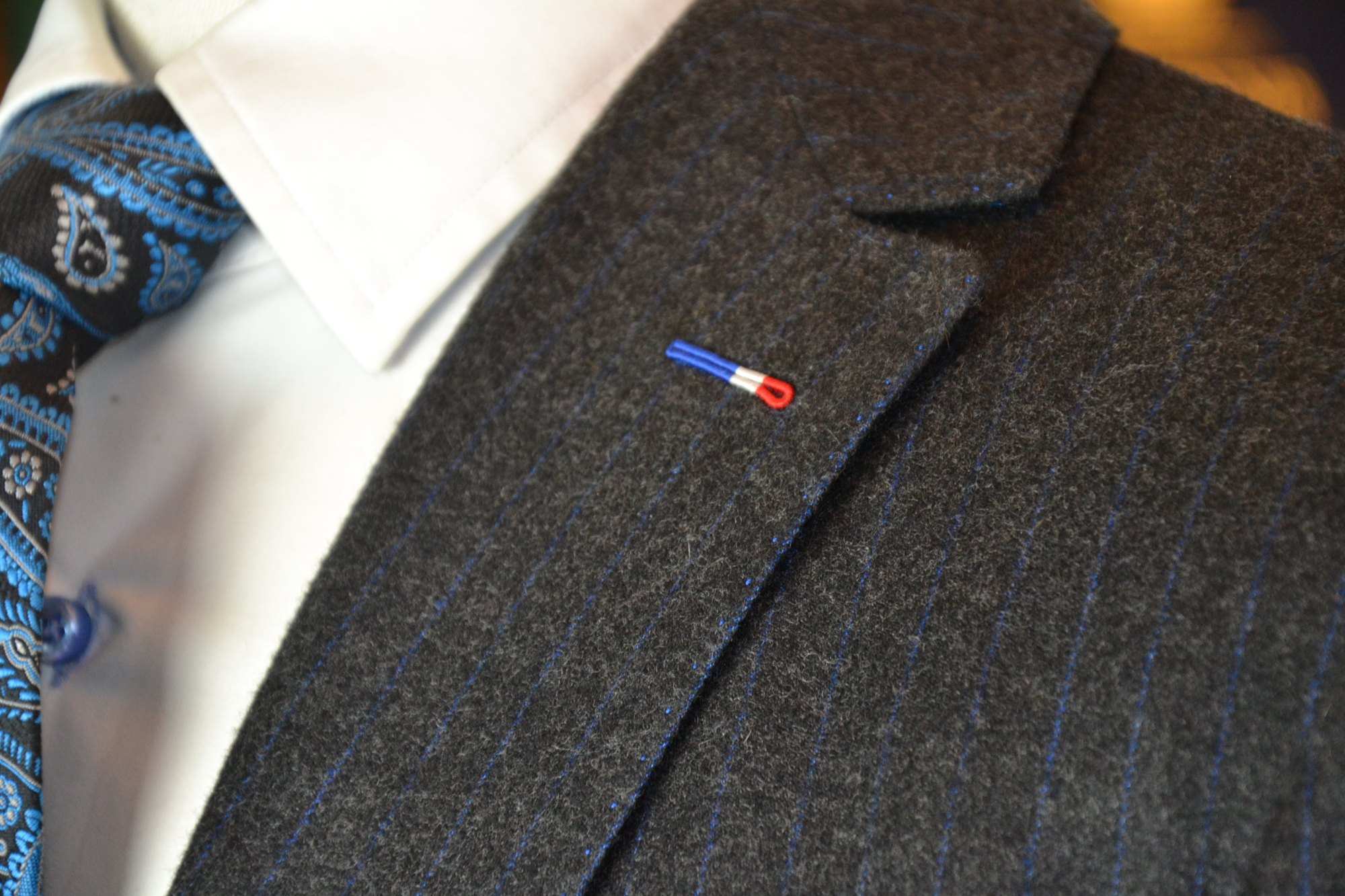
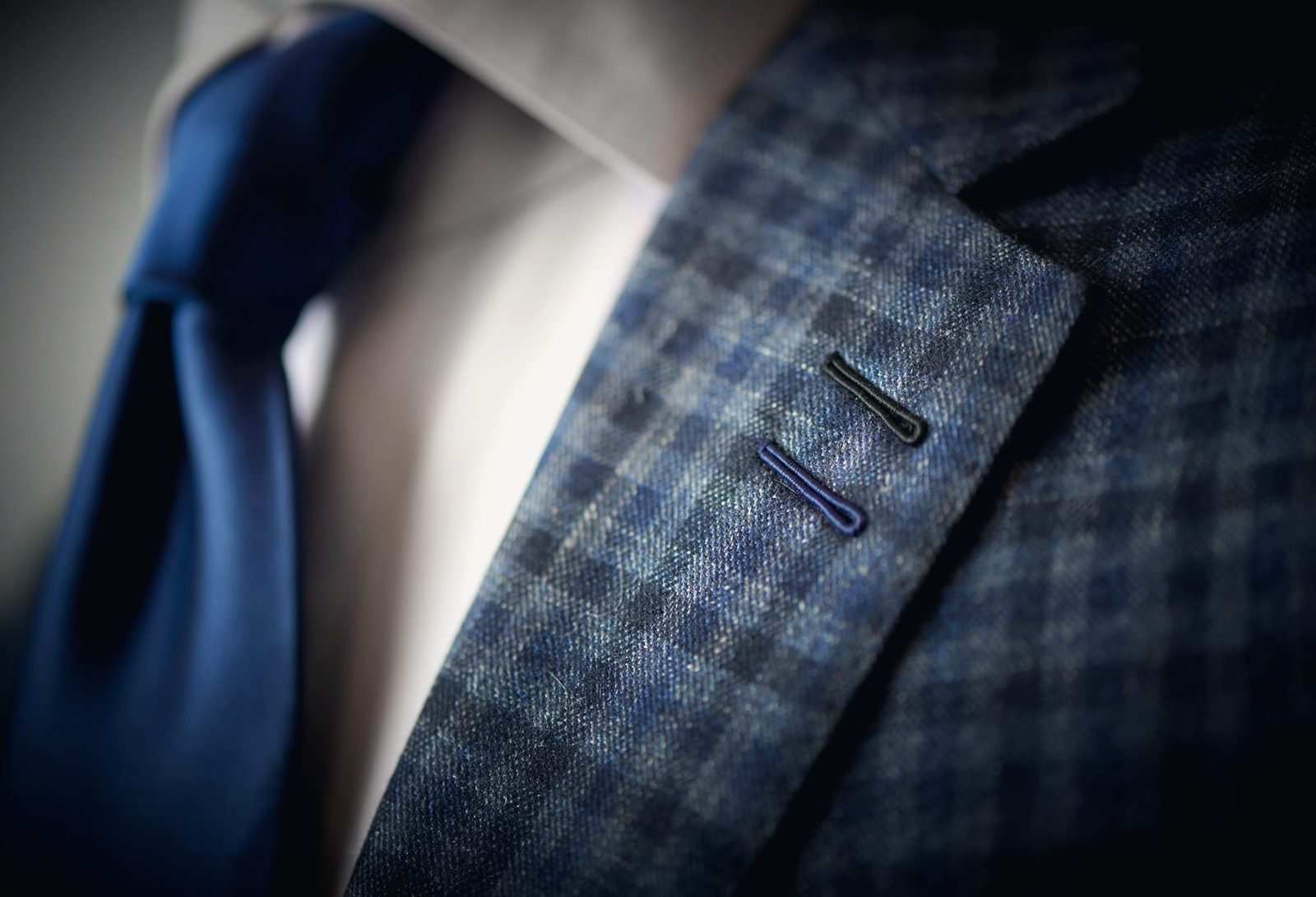
Embroidered in relief over a cord, the Milanese buttonhole is the house signature, found in every collection. Here in blue, white and red, on a charcoal flannel.
Along the lapel, small blue stitches echo the stripe of the cloth. From the Premium collection upwards, this pick stitching can be done by hand, depending on the collection.
From the Premium collection upwards, the collar and shoulders are set by hand: the lapel rolls naturally and the jacket hugs the nape of the neck.
The blue of the fine stripe returns in the buttonhole and in the pick stitching. Matching the colours, from thread to cloth, is possible from the Découverte collection upwards.
Beneath the jacket, a bespoke shirt with a crisp, structured white collar. Height, spread, point length: each collar is drawn in the salon, to suit your face.
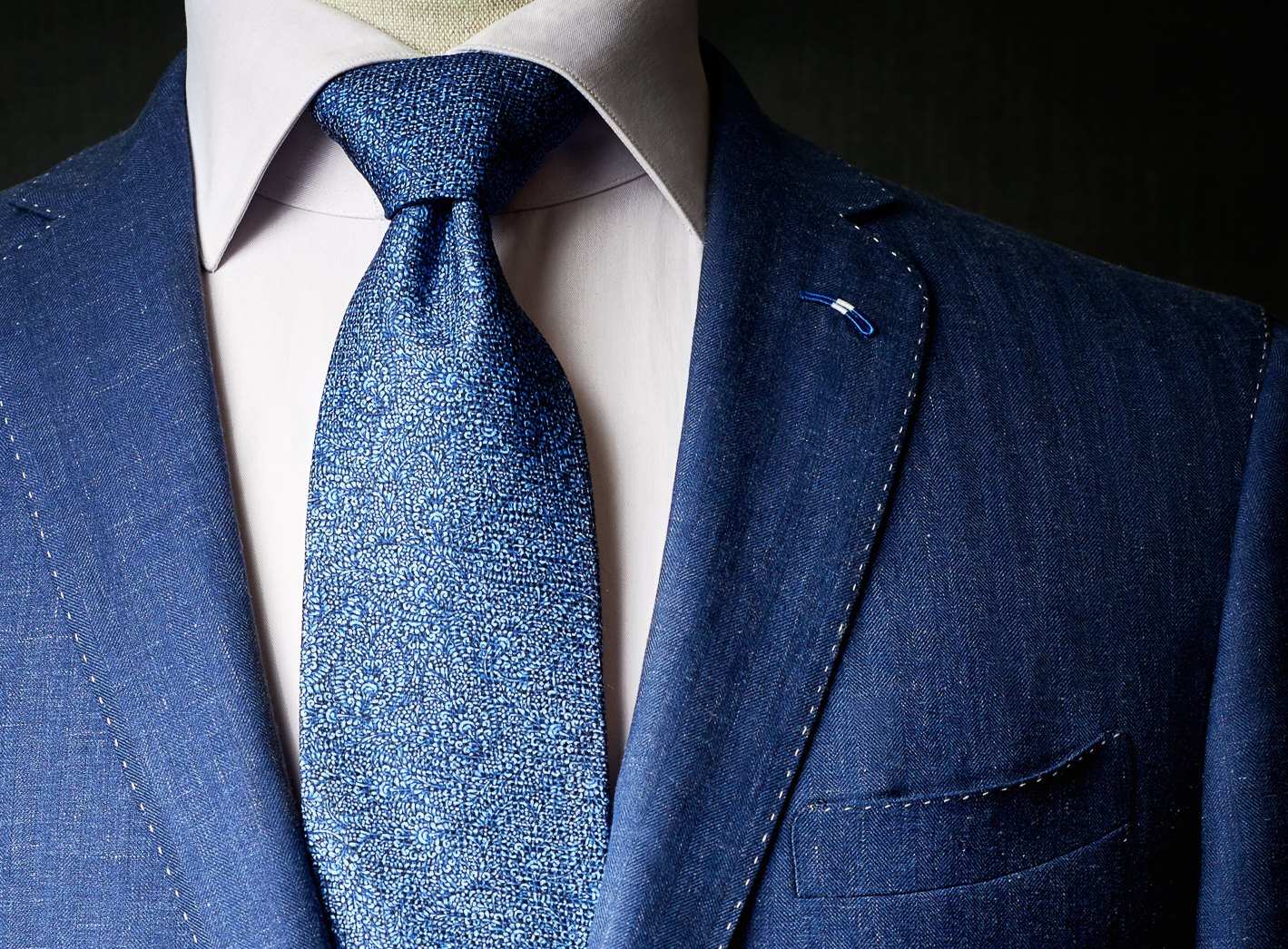
Two shades on a single buttonhole: royal blue and white, matched to the pick stitching. The house signature, the Milanese buttonhole comes with every collection, in the colour of your choice.
An even white stitch traces the edge of the lapel against the blue of the cloth. From the Premium collection upwards, pick stitching can be done by hand, depending on the collection.
It carries the same white pick stitching. It can hold a square cut from the lining, left to show like a pocket square, or a pocket square chosen separately: matching, or entirely off-key.
A blue herringbone flecked with white, in conversation with the pick stitching. The cloth guides the choice of thread: colour matching is available from the Découverte collection upwards.
The stitching runs from the lapel to the bottom of the front in a single line. A detail that lightens the look of the jacket, at the office as at the weekend.
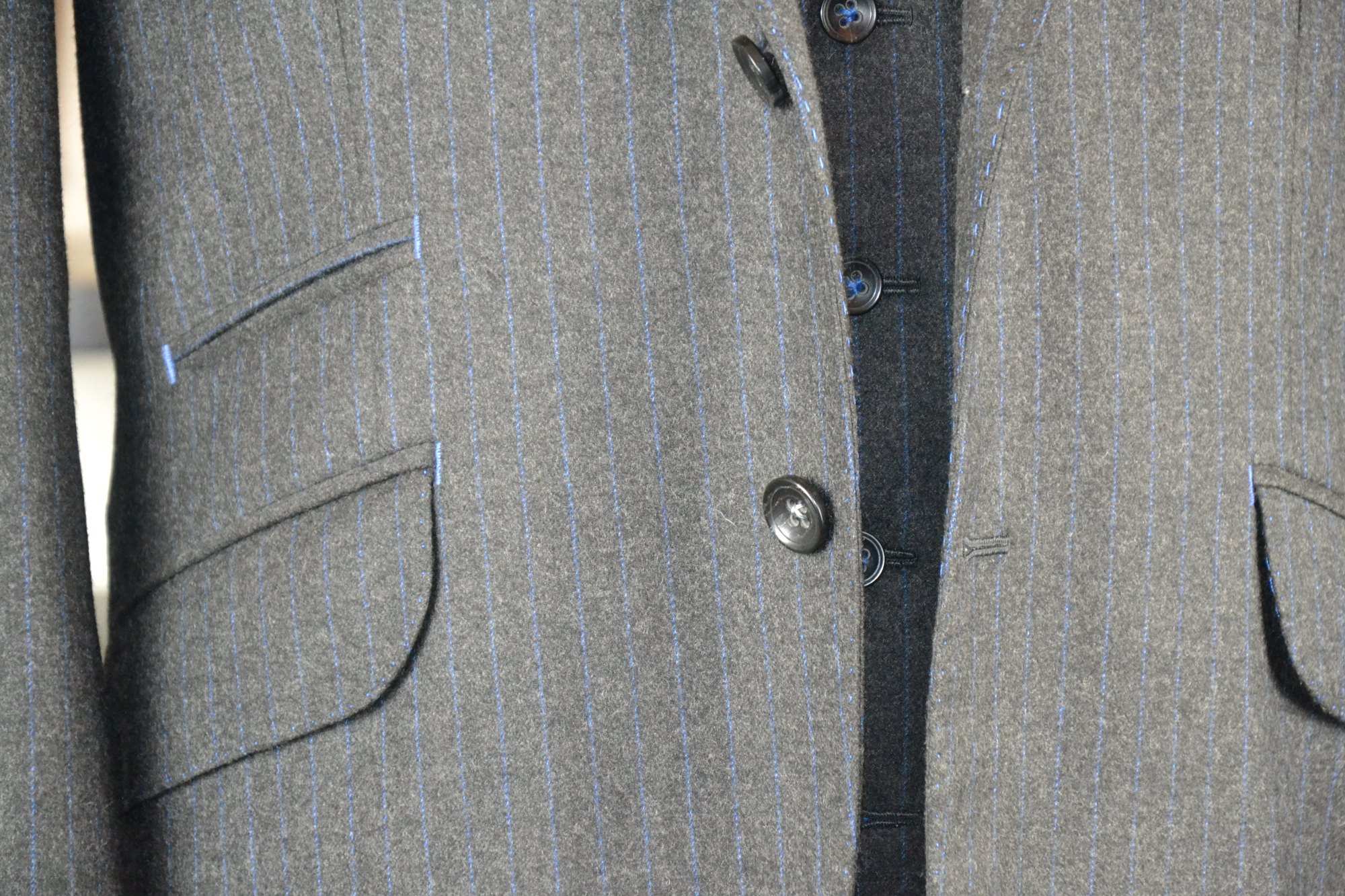
A small jetted pocket, set at a slant above the flap pocket. Designed originally for a train ticket, it gives the jacket a touch of British elegance.
Each end of the pocket is secured with a bar tack embroidered in blue, matched to the stripe. A discreet colour match, available from the Découverte collection upwards.
A slightly slanted flap pocket, whose flap can be tucked inside. From the Premium collection upwards, pocket finishes can be done by hand, depending on the collection.
A fine blue stitch edges the front of the jacket up to the lapel. From the Premium collection upwards, this pick stitching can be done by hand, depending on the collection.
The waistcoat completes the three-piece, in a shade matched to the jacket. Its height, its number of buttons and the shape of its hem are decided in the salon.
Buttons are chosen from a range of materials and shades. The thread that holds them can change colour too: a match available from the Découverte collection upwards.
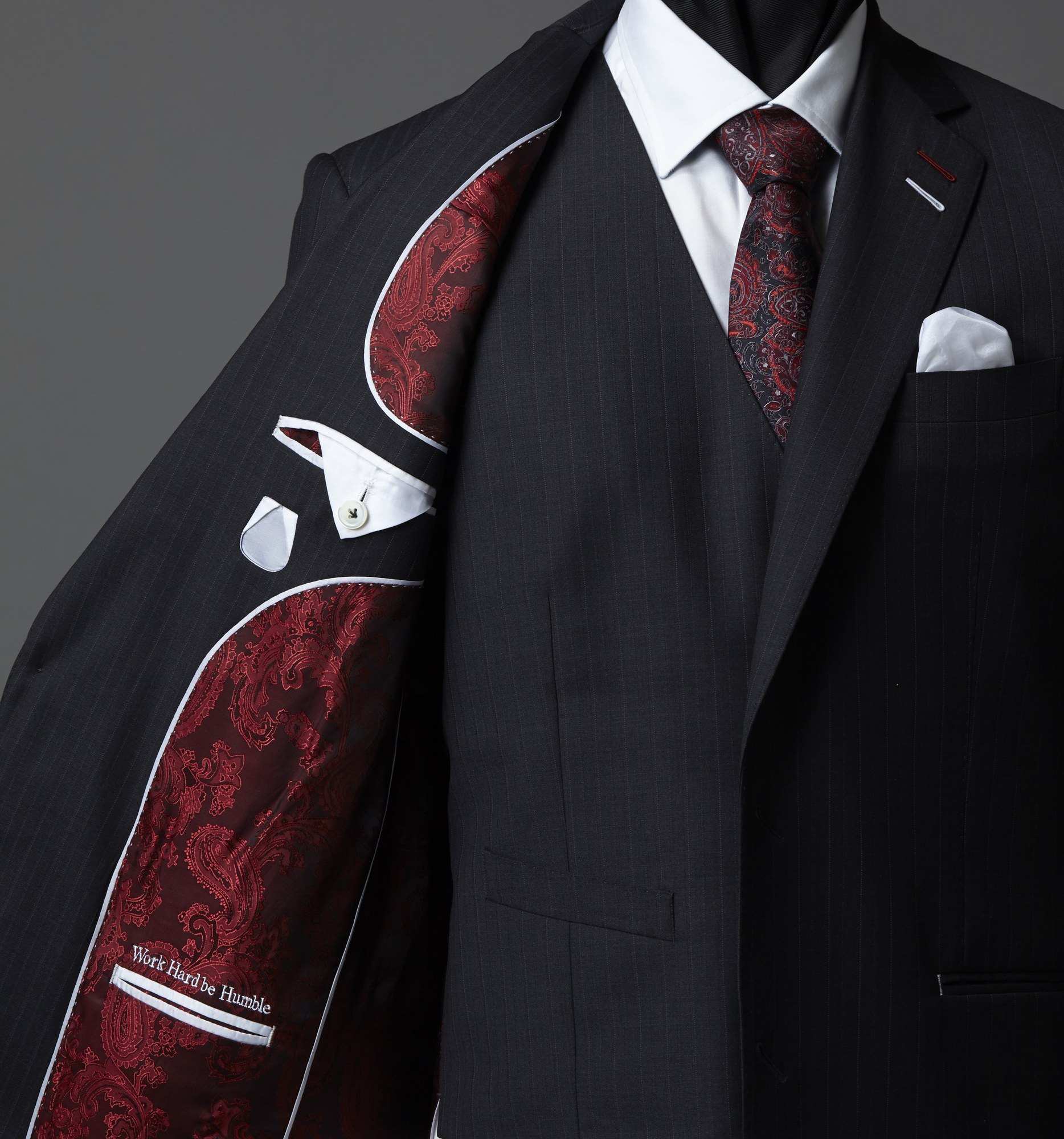
A lapel buttonhole embroidered in a burgundy matched to the lining. Coloured buttonholes and colour matching are available from the Découverte collection upwards: a detail that signs the piece without shouting it.
From the Premium collection upwards, the collar and shoulders are set by hand: the jacket hugs the nape of the neck, moves with you and falls with greater ease.
The inside pocket closes with a triangular tab and a mother-of-pearl button, beneath white piping. A discreet touch, designed to keep wallet and phone in their place.
A fine white piping outlines the facing and follows every curve of the lining. The contrast shows only when the jacket opens, like a confidence.
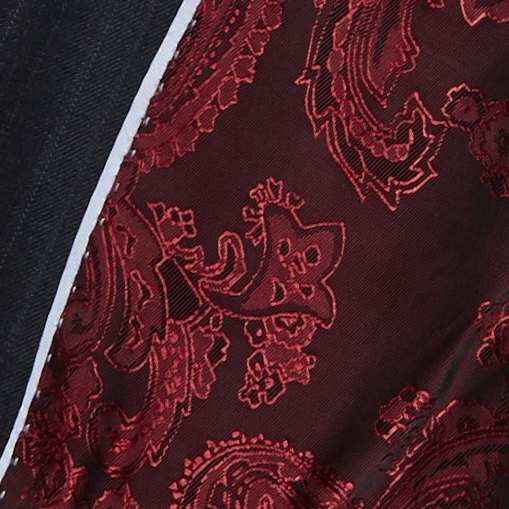
Here, a burgundy paisley jacquard. In Bemberg or silk, the lining is chosen from the atelier's swatch books: plain for restraint, patterned for boldness, always matched to the cloth.
A motto, a date, initials: embroidered above the inside pocket, they are for you alone. Here, “Work Hard be Humble”, in white thread on the lining.
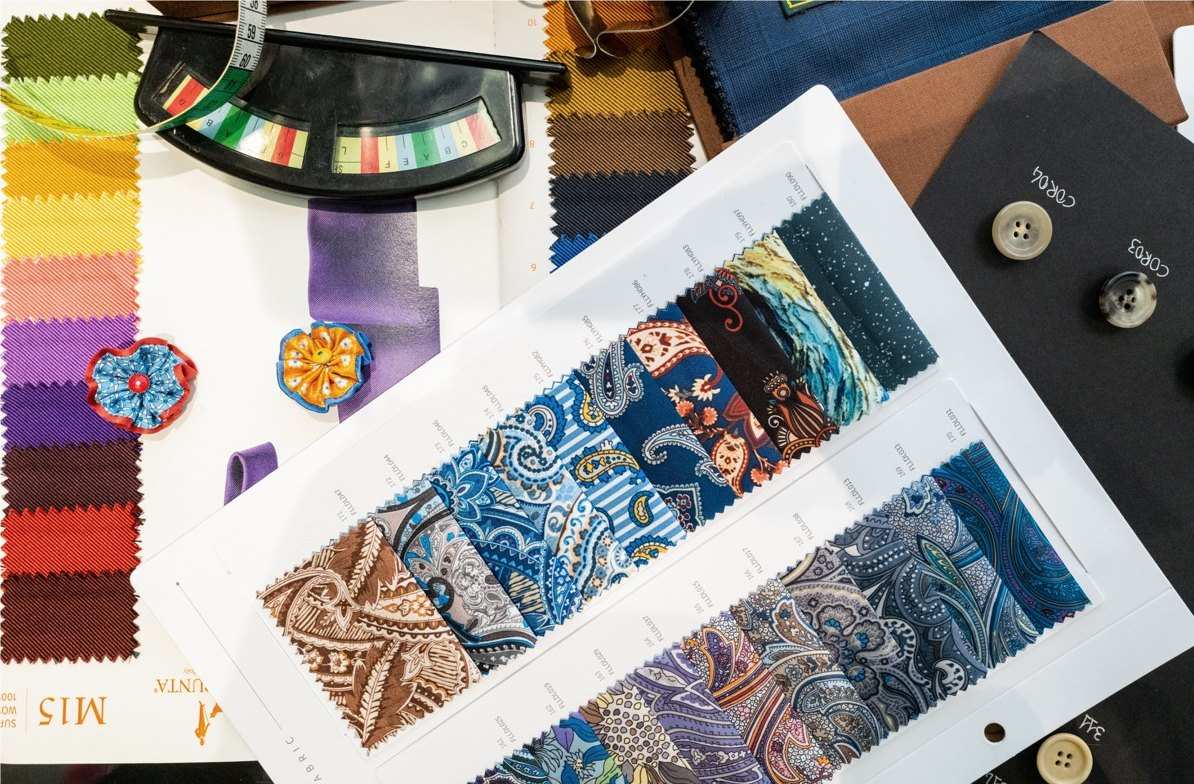
Paisley, floral or graphic: the lining is chosen in Bemberg or silk, from the atelier's swatch books. A boldness kept inside, revealed only when the jacket opens.
From saffron yellow to burgundy, a range of plain linings to match the inside to the cloth, the tie or the buttonhole. Colour matching is available from the Découverte collection upwards.
Light, dark or variegated, buttons are laid on the cloth before they are chosen. With the thread and the buttonhole, they make up the final combination of the jacket.
Prince of Wales check, plain or herringbone: the cloth sets the tone, and every other choice is built around it, from the lining to the buttonhole thread.
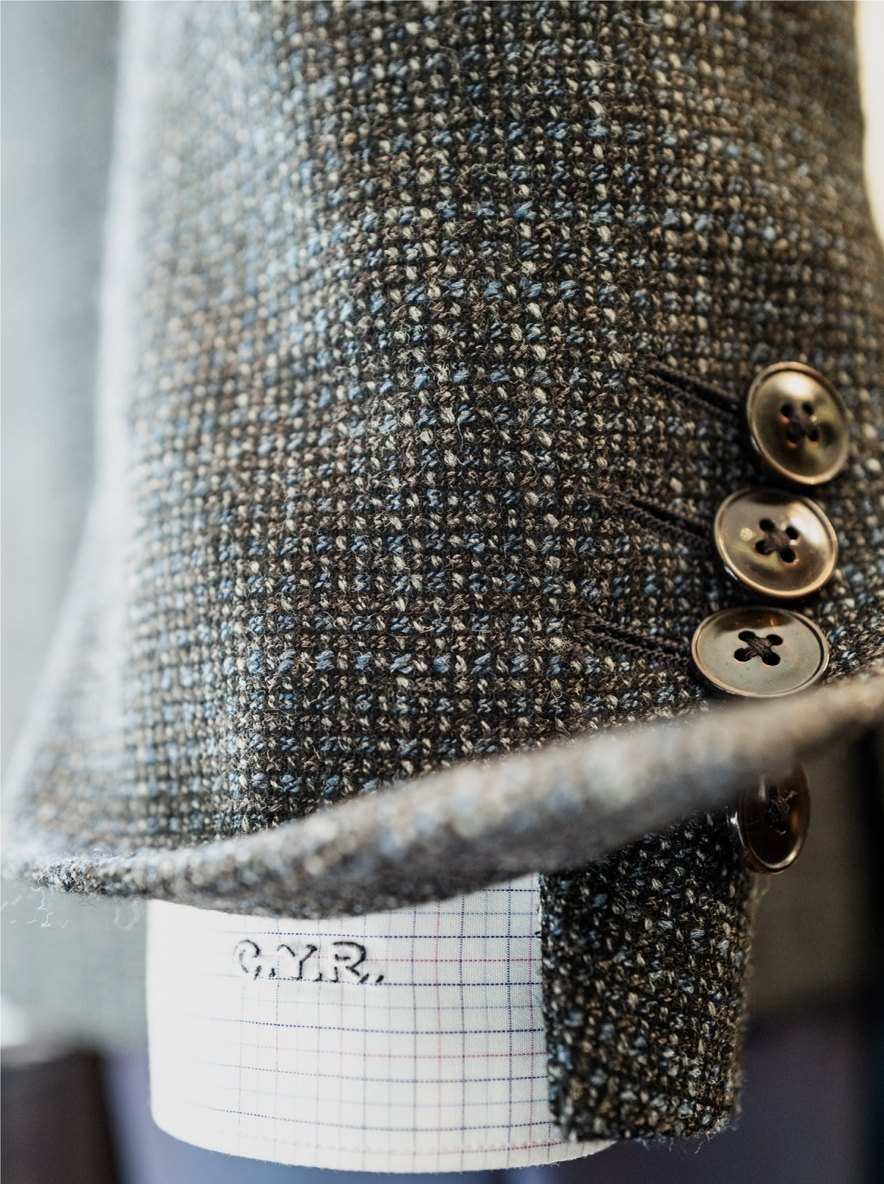
Four buttons set in a cascade, overlapping slightly. Their number, their material and the colour of the thread that holds them are decided together, in the salon.
Tone on tone here, sleeve buttonholes can also be embroidered in colour. An option available from the Découverte collection upwards, revealed only with a gesture.
Embroidered on the shirt cuff, the initials appear just below the jacket sleeve. A personal signature, visible for the length of a gesture.
A heathered tweed in grey, brown and blue, with a soft drape. For a winter jacket, the cloth is chosen from the swatch books in the salon, by touch as much as by eye.
Touch a gold point to look closer.
| The detail | What it changes | My advice |
|---|---|---|
| The shoulder | Built up, it draws a clean line and lends authority. Natural, set in like a shirt sleeve, the Neapolitan spalla camicia, it moves with you. | Built up for the boardroom; natural for a jacket worn from morning to dinner. |
| The armhole | Cut high and close, it frees the arm without the jacket riding up. | High, always: it is the secret of a jacket you forget you are wearing. |
| The lapel and the notch | The notch lapel is classic, the peak lapel dressier, the shawl collar reserved for the dinner suit. The width of the lapel follows the breadth of the shoulders. | Neither too narrow, which dates a suit, nor too wide: in proportion to your shoulders. |
| The gorge | The seam that joins the collar to the lapel. Set high, it lengthens the torso. | High, for a long and slender silhouette. |
| The buttoning | One button for the evening, two for balance, three rolled to two for Neapolitan ease, six on a double-breasted for presence. | Two buttons for a first suit; the double-breasted once the wardrobe is established. |
| The pockets | Jetted, the most formal; flapped, versatile; patch, more relaxed. A ticket pocket adds an English note, a curved barchetta breast pocket a Neapolitan one. | Flap pockets for every day, jetted for ceremony. |
| The vents | Two side vents give ease when seated and in motion; a centre vent is more traditional; with no vent, the line is cleaner. | Two vents, for most figures. |
| The trousers | Pleated or flat-fronted, high-waisted or classic rise, side adjusters, plain hems or turn-ups. | A single pleat and a slightly higher waist lengthen the leg; turn-ups on winter cloths. |
| The waistcoat | Single- or double-breasted, backed in the suit cloth or in lining, with a watch pocket. | Double-breasted for a ceremony, single-breasted for the office. |
And to finish: buttons in horn, mother-of-pearl or corozo, working buttonholes at the cuff, pick stitching done by hand in the higher collections, initials embroidered inside and, for a groom, the date of the wedding.
05 · Suits
The Milanese buttonhole, the house signature
On every L'Atelier Hoche suit, whatever the collection, the lapel carries a Milanese buttonhole: a raised silk cord, worked close stitch by close stitch, that forms a clean, slightly domed teardrop. It takes a flower on a wedding day, a pin on a tuxedo for a gala evening; the rest of the time, it simply says that the suit was made for you. Tone on tone for discretion, or contrasting as a signature.
06 · Suits
The inside, your secret garden
More than 400 linings await your suit. Bemberg, a cupro fibre that breathes like silk and glides over the shirt, for everyday comfort; silk, for softness and lustre. Plain and matched to the cloth, for restraint; or printed — paisley, geometrics, artists' designs — for a brilliance revealed only when the jacket falls open.
400linings, Bemberg and silk, at the atelier
Burgundy paisley jacquardPlain, in the tone of the cloth, or printed for a flash of colour revealed only when the jacket opens. More than 400 linings to choose from at the salon, swatch book in hand.
07 · Suits
Pattern, canvas, full bespoke: how your suit takes shape
Every suit is born of your pattern, drawn for you alone from all your measurements: that is what bespoke means here, and it is the house standard.
Between the cloth and the lining, a canvas gives the front its body and its memory: with wear, the jacket moulds itself to your chest. This is how the great houses build a jacket. The Découverte collection is half-canvassed: the canvas holds the upper front, where the roll of the lapel and the set of the chest are decided. Every other collection is fully canvassed. From Découverte upwards, the armhole is set by hand; from Premium, the collar and shoulders are too, which gives a close cut its suppleness in movement.
From one collection to the next, the hand takes a growing share, from setting the collar to the buttonholes on the front, and the cloths grow rarer, until 80% of the work is done by hand in full bespoke. The style options, by contrast, are all open from Découverte. In every collection, a fitting toile can confirm your pattern before the cloth is cut; at the top, the Sartoriale collection, crafted in Italy and fitted in Paris, adds an intermediate fitting to set every line to the millimetre.
08 · Suits
Which cloth for which season?
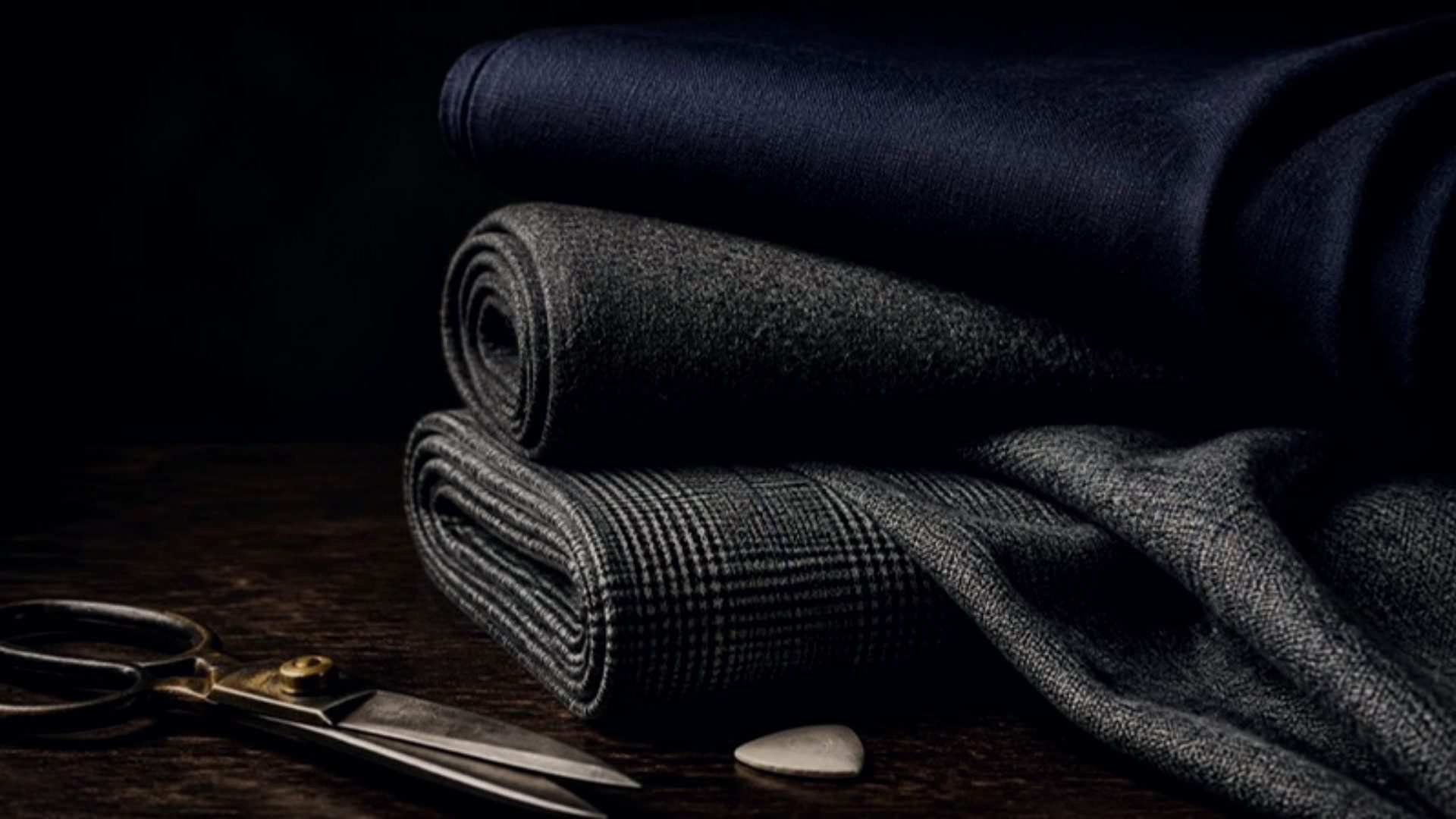
I work with the great cloth houses — Vitale Barberis Canonico, Ermenegildo Zegna, Holland & Sherry, Dormeuil, Piacenza, Reda, Drago and many others — swatch books in hand, in the salon. Every season has its cloths.
| Season | Cloths | Approximate weight | What it brings |
|---|---|---|---|
| Autumn and winter | Flannel, carded wool, tweed, cashmere, wool and silk | 330 to 400 g/m | Drape, warmth, a cloth that takes on a patina with grace |
| All year round | Worsted Super 110s to 130s, twill, birdseye, pinhead | 260 to 300 g/m | The working week's wardrobe: it travels, sheds its creases and lasts |
| Spring and summer | Cool wool, fresco, kid mohair, linen, wool and linen | 220 to 260 g/m | Air, lightness, a sheen in the light |
| Great occasions | Super 150s to 180s, cashmere, vicuña in the Sartoriale collection | Depending on the cloth | An exceptional hand, best kept for pieces worn with care |
A Super 180s is softer than a Super 120s, but also more fragile: for a suit worn three times a week, I recommend a sturdier wool and keep the finest for the evenings that count. You will find them all on the fabrics and ranges page.
09 · Suits
Where should a wardrobe begin?
A wardrobe is built like a library: classics first. Here is the order I suggest most often.
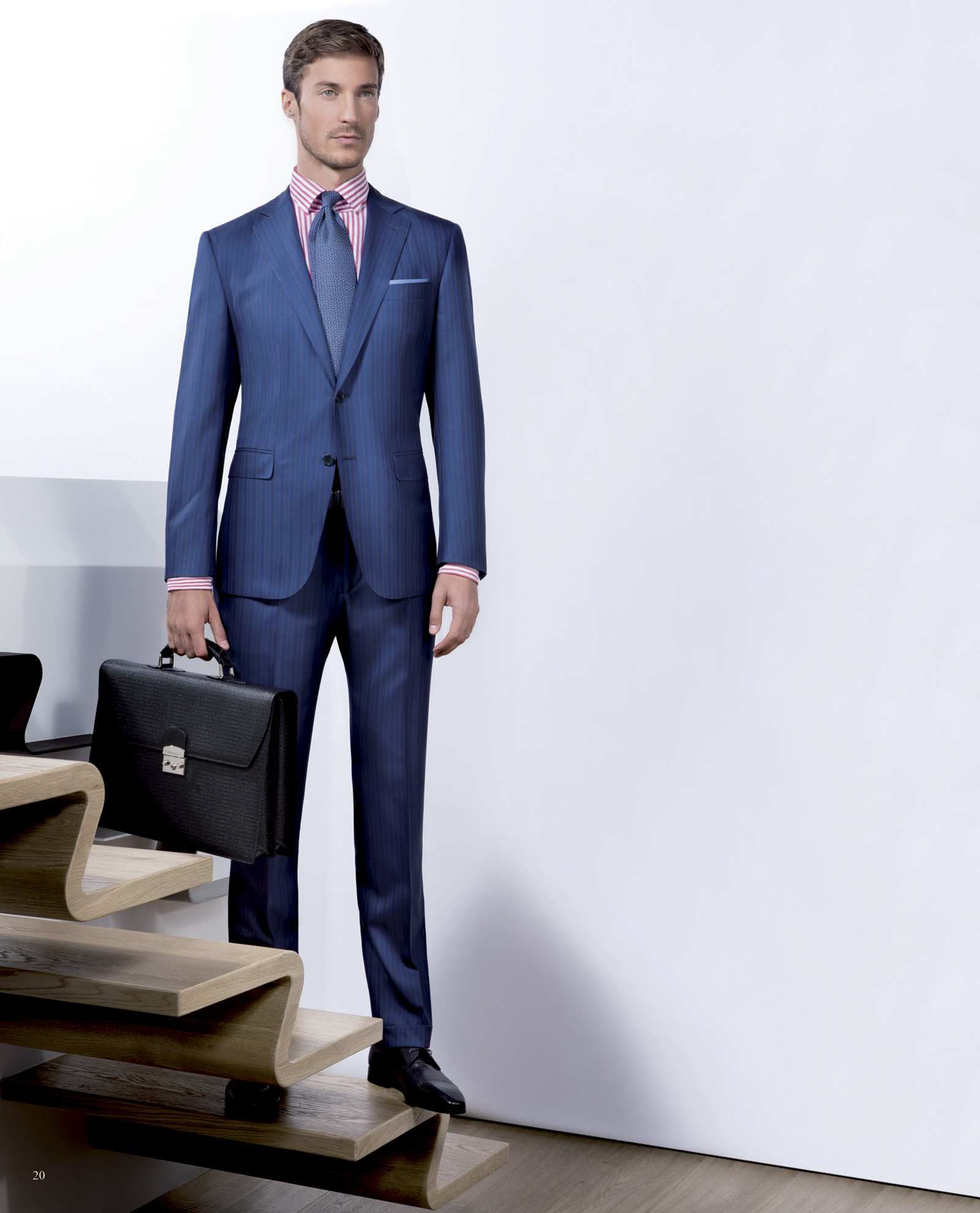
- Plain navy, in an all-season wool: it goes from the boardroom to dinner and takes any shirt.
- Charcoal or mid grey, plain or birdseye: rigour, and the natural partner for the boldest ties.
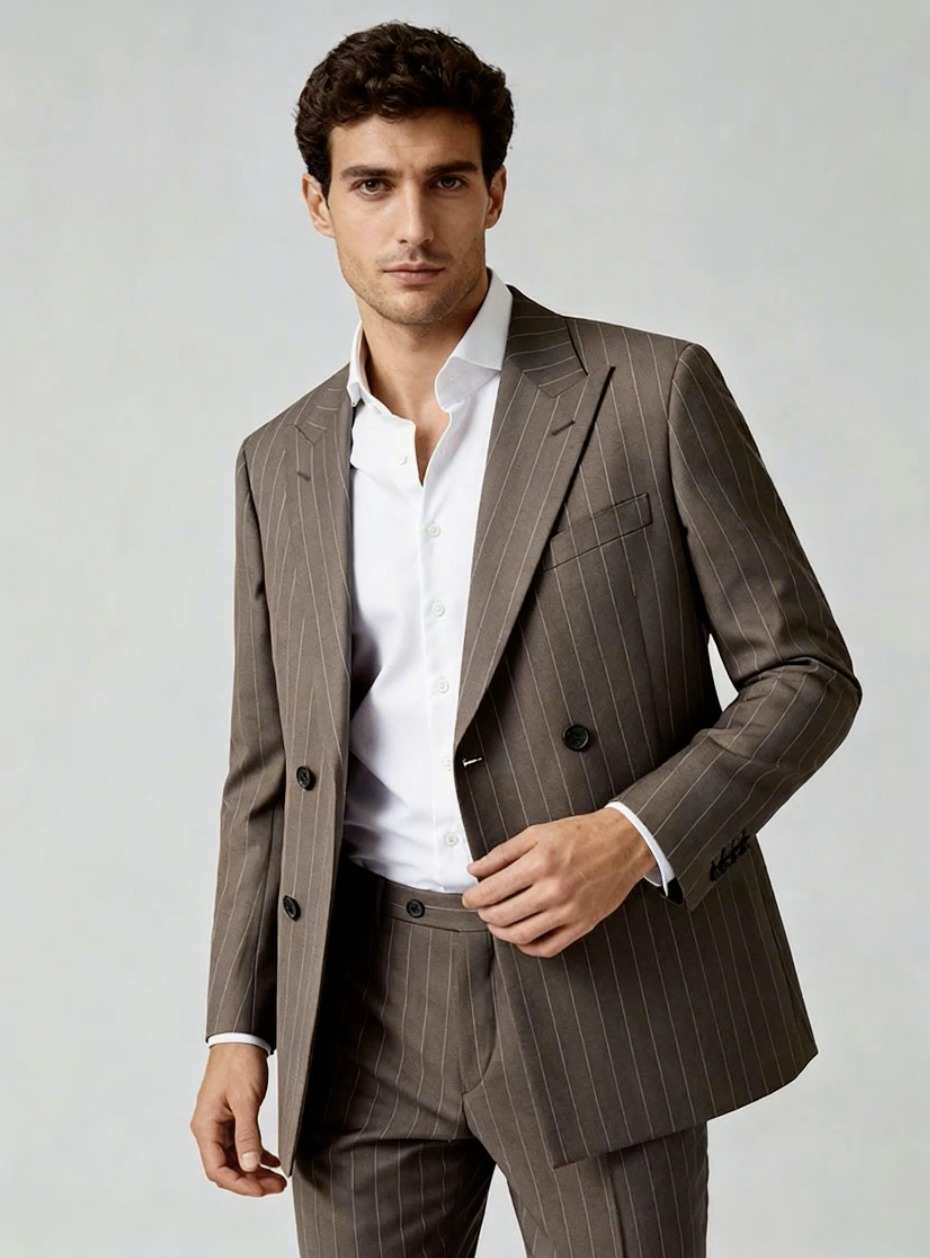
- A pattern: a chalk stripe or pinstripe for authority, a Prince of Wales check for English elegance, a grey flannel for winter.
- An odd jacket and two pairs of trousers: smart casual, which multiplies the outfits without multiplying the pieces.
- The double-breasted, once the wardrobe is established: in midnight blue or grey, it gives a silhouette its signature.
For an executive or a lawyer, I like to begin with navy and charcoal; for an entrepreneur, with navy and an odd jacket.
10 · The collections
How much does a luxury bespoke suit cost?
A first bespoke two-piece suit starts at €1,380, cloth included. The price follows the construction, the share of handwork and the cloth; and because your pattern then already exists, our prices come down with each order that follows.
The waistcoat of a three-piece is priced in addition to the suit; the final price is set with you, at the atelier, cloth in hand.
Level 01 · 20% of the work by hand
Découverte
The doorway to bespoke.
Cloth ranges available
- Découverte
- Maison (not included)
- Privilège (not included)
- Signature (not included)
Level 02 · 30% of the work by hand
Mesure
More structure, more choice.
Cloth ranges available
- Découverte
- Maison
- Privilège (not included)
- Signature (not included)
Level 04 · 80% of the work by hand · Full bespoke
Fait main
Full bespoke, the summit of the house.
Cloth ranges available
- Découverte (not included)
- Maison (not included)
- Privilège
- Signature
11 · The Sartoriale collection
Our full bespoke, the height of comfort and presence
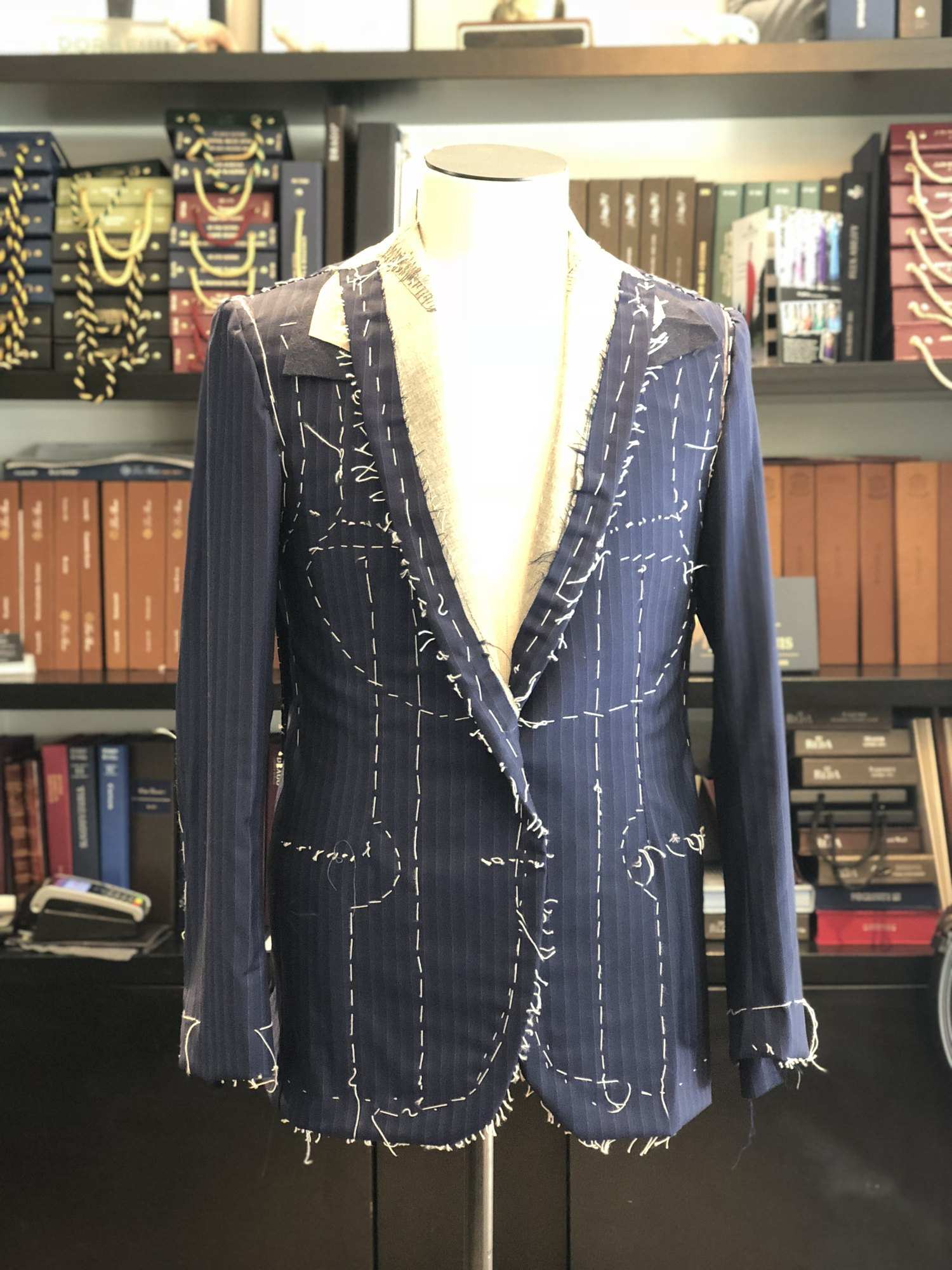
At the summit of the house stands the Sartoriale collection, crafted in Italy and fitted in Paris. Here the suit is built on you: the jacket is presented to you still basted, in white thread, and every line is set on your own figure before it is fixed for good. The result is a comfort that cannot be seen but is felt from the very first hour, and a presence that stays with you.
- The baste fittingAn intermediate fitting, the jacket held together in thread, to settle the balance, the shoulder and the drape to the millimetre; then the final fitting at the atelier, pin in hand.
- The rarest clothsSuper 180s, cashmere, vicuña: the Privilège and Signature ranges are open to you, swatch books in hand.
- The secret of the detailsEverything that shows only when the jacket is opened, and belongs to you alone.
12 · The private salon
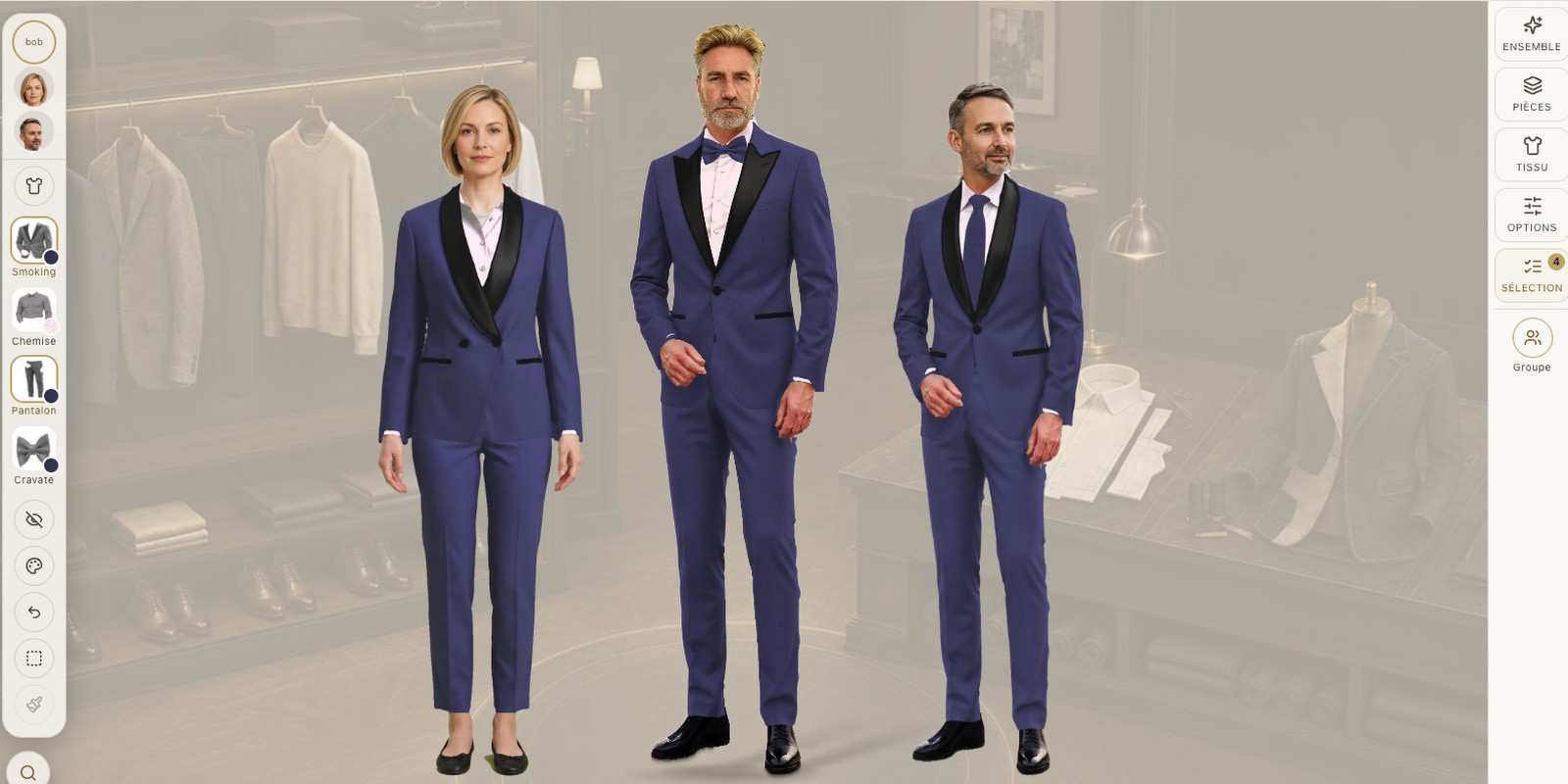
Sketch your next suit
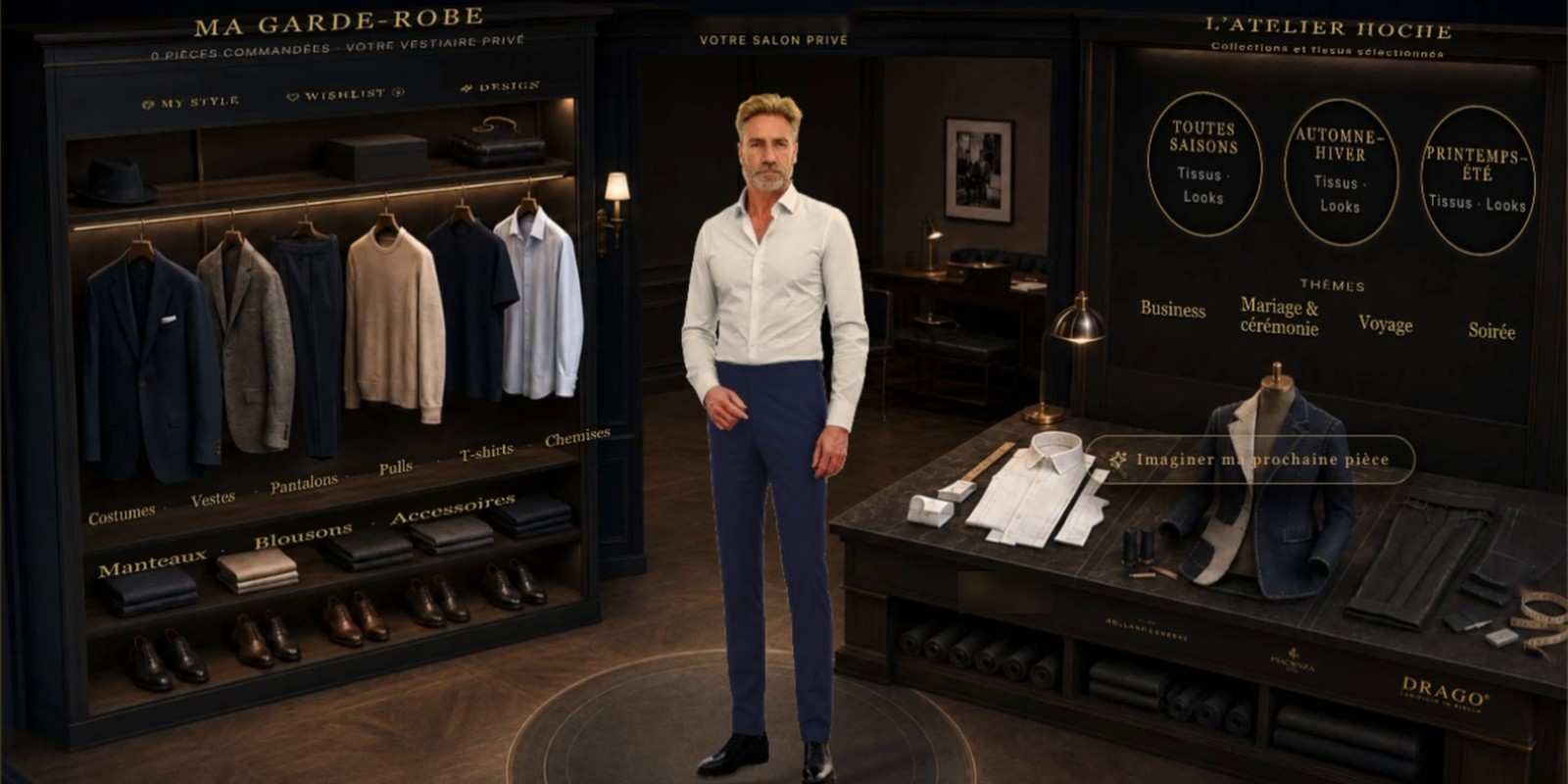
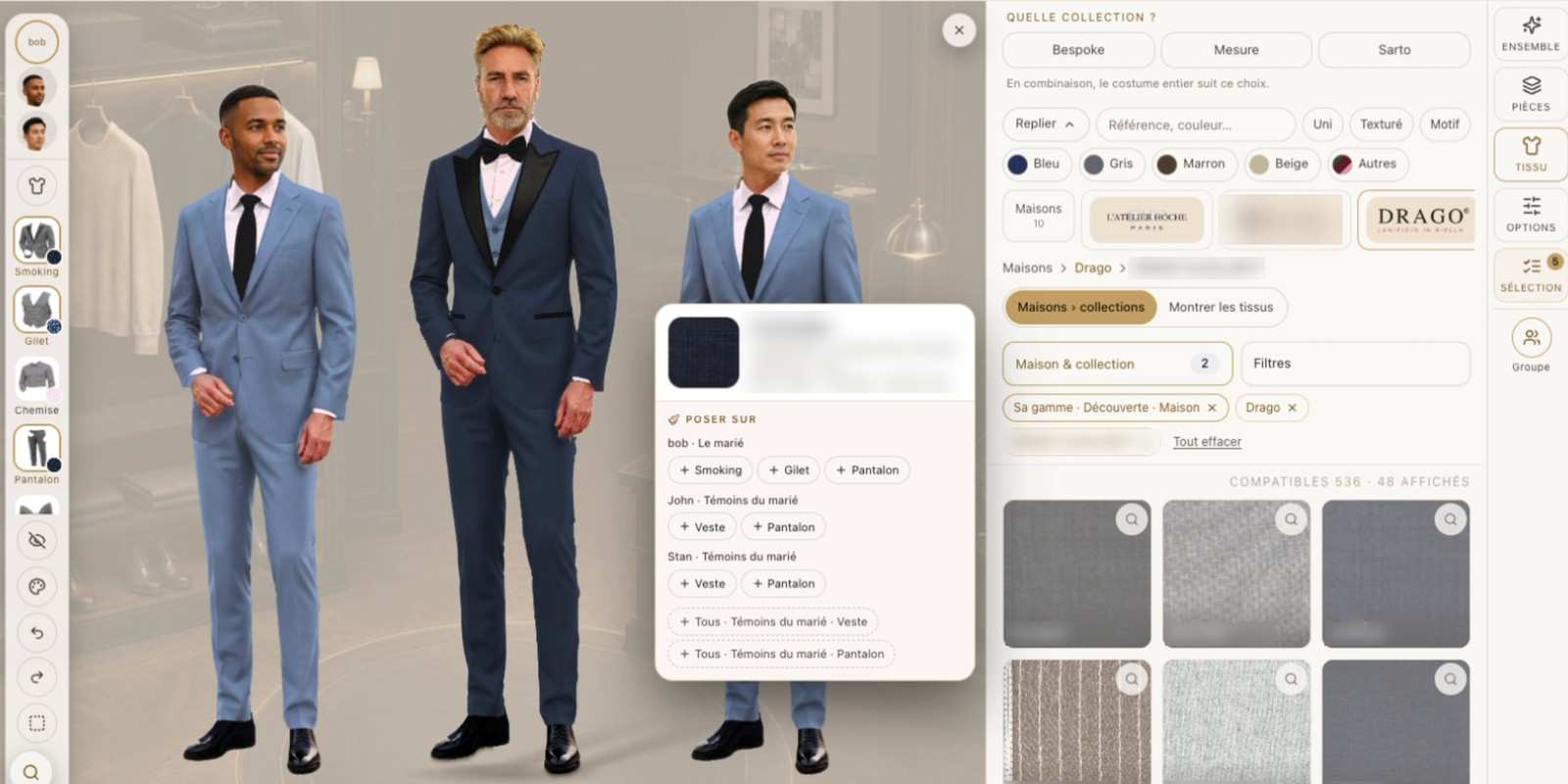
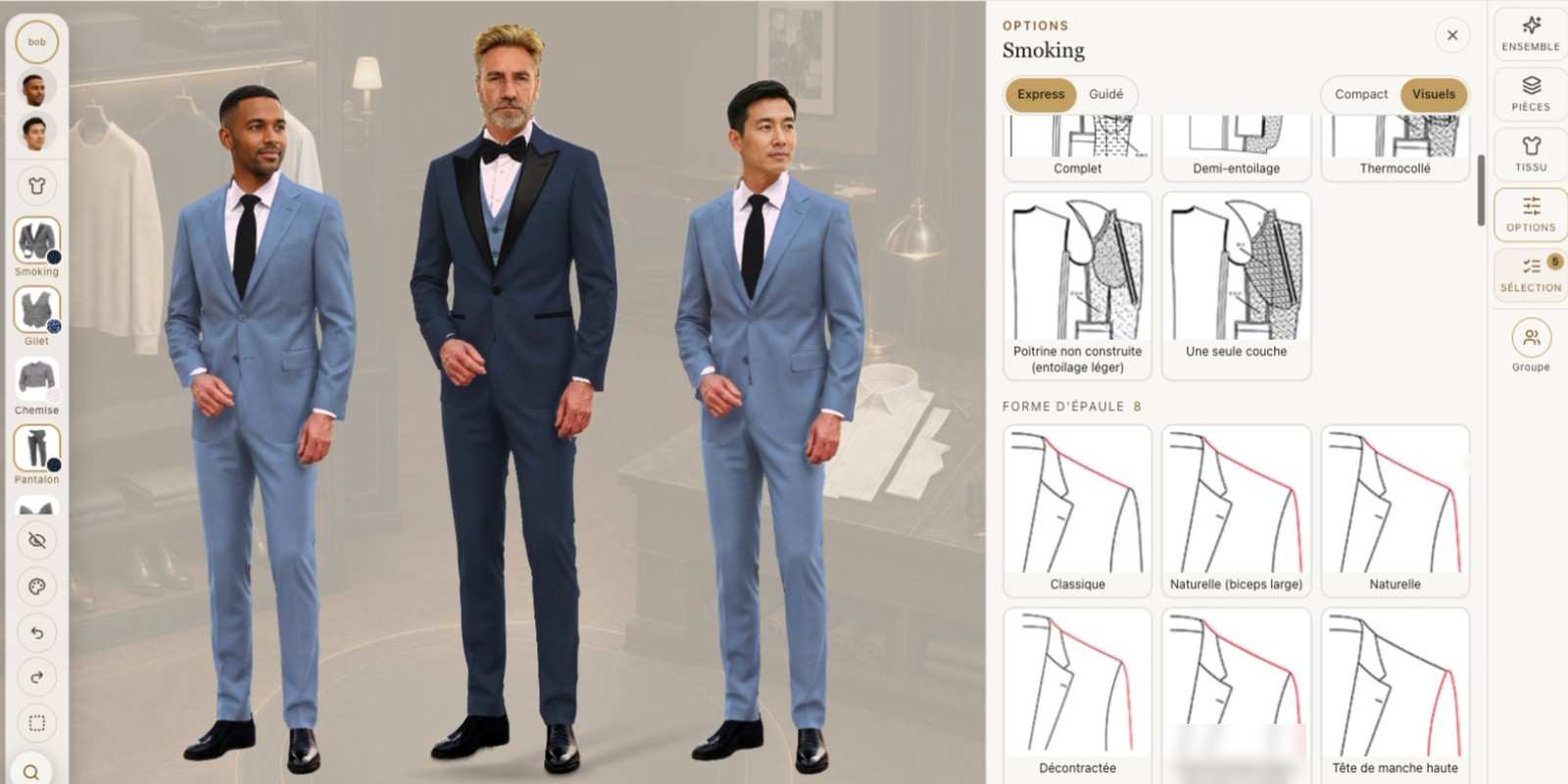
Choose a cloth, a lapel, a lining: the house suit comes to life before your eyes. It is only a foretaste. Once I have taken your measurements and approved your fitting, I open your private salon to you: there, your avatar wears your pattern, every cloth in your collection and every detail lies within reach, and your compositions await you for the next piece. To go further today, the house configurator opens the private salon's rendering engine, for the length of a sketch.
13 · Suits
From first meeting to delivery, three to six weeks
- The meetinga first conversation, at the atelier or by video call: your life, your occasions, what you expect of this suit.
- The measuringan hour at the atelier, with me: all your measurements, your posture, your pattern; the choice of cloth and details, swatch books in hand. From your first order, I build your avatar.
- The fittingstwo to three, in Paris; a fitting toile if you wish, an intermediate fitting in full bespoke. I approve every line, pin in hand.
- The handoverthe final fitting at the atelier; then your suit joins your wardrobe.
- Your private salononce your fitting is approved, I open it to you online, so that you can compose your next pieces, day and night.
Frequently asked questions
What we are asked
How much does a luxury bespoke suit cost in Paris?
From €1,380 for a first two-piece, cloth included, in the Découverte collection, then €1,200 once your pattern has been created; €1,550 in the Mesure collection, €2,380 in Premium and €3,150 for full bespoke in the Sartoriale collection. The final price depends on the cloth and the level of construction; we set it together, at the atelier, before any order is placed.
Who takes my measurements and carries out my fittings?
I do: Christian Y. Rousset, founder of the house. On avenue Hoche, I am your sole point of contact: I receive you, take your measurements, compose each piece with you and approve every fitting until the day the suit is handed to you.
When can I enter my private salon?
As soon as I have taken your measurements and approved your fitting. Your avatar then wears your pattern, and you compose your next pieces online, day and night. Until then, the house configurator gives you a first taste, with no need to register.
How long does a bespoke suit take?
Three to six weeks from measuring to delivery, depending on the collection and the cloth. That includes two to three fittings in Paris. If there is a date to meet — a wedding, a ceremony, taking up a new post — tell me at our first meeting: I will arrange the fittings around it.
Made to measure, bespoke, full bespoke: what is the difference?
Made to measure adjusts an existing pattern. Bespoke, our standard, creates a unique pattern from all your measurements. Full bespoke carries the greatest share of handwork, with an intermediate fitting to confirm every line: that is our Sartoriale collection.
What is a canvassed suit?
A canvas is placed between the cloth and the lining of the jacket front. It gives the chest its body and lets it mould itself, wear after wear, to the shape of your torso. Our Découverte collection is half-canvassed; every other collection is fully canvassed. The share of handwork and the cloth vary with the collection.
How many fittings does a bespoke suit need?
Two to three, in Paris. In every collection, a fitting toile can confirm your pattern before finishing; in full bespoke, the intermediate fitting is a matter of course. Every correction is carried over to your pattern, for the pieces that follow.
What if my figure changes?
Your pattern changes with you: it is kept and updated with every piece. For a suit already delivered, we see together, at the atelier, what its construction allows us to alter.