The tuxedo, to your measure.
Bespoke tuxedos for men, avenue Hoche, Paris 8th.
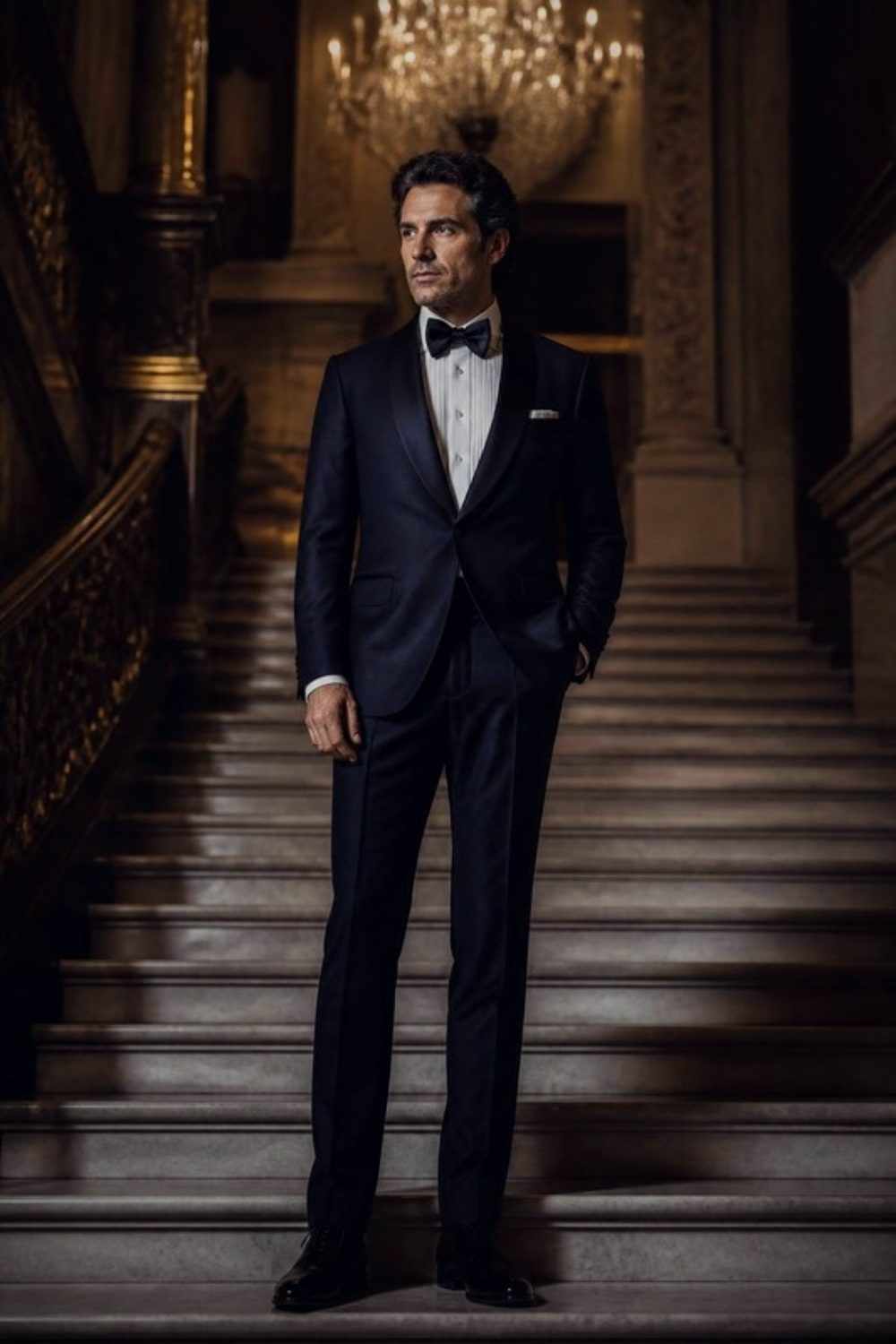
A gala, an opening night at the Opéra, the night of your wedding: some evenings stay with you for a lifetime. Your tuxedo is made for them, on a pattern that bears your name, drawn from more than thirty measurements. I choose the cloth with you; the details are yours alone to decide. At midnight, it falls as true as it did at the first toast.
01 · Tuxedos
What difference does a bespoke tuxedo make?
A tuxedo is judged at midnight. You sit, you dance, you raise your glass: the shoulder stays in place, the collar sits close to the neck, the silk lapel holds its line. Such is the privilege of a pattern created for you alone. And this tuxedo is yours to keep: it waits for next year’s gala, a friend’s wedding, every evening still to come.
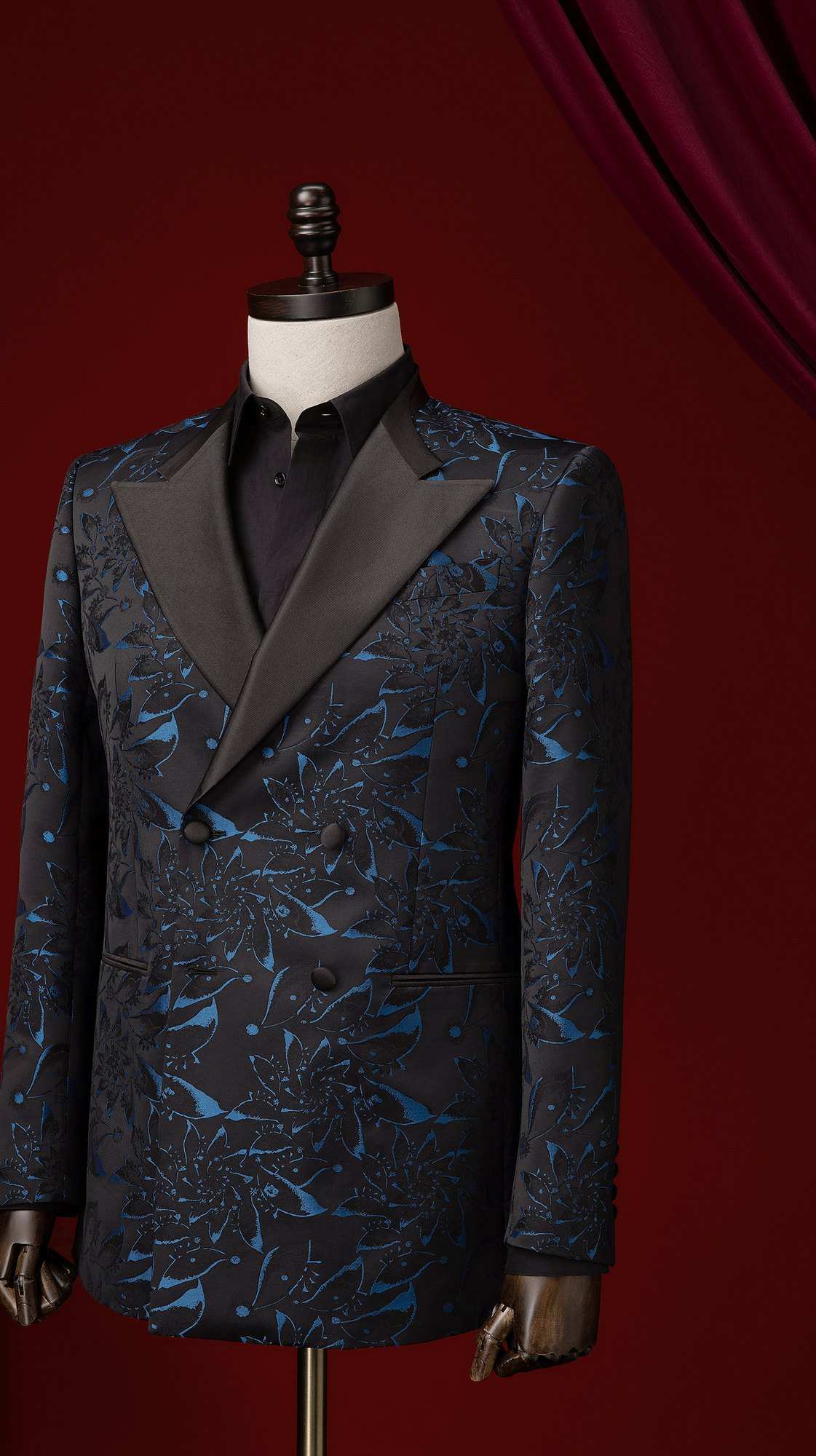
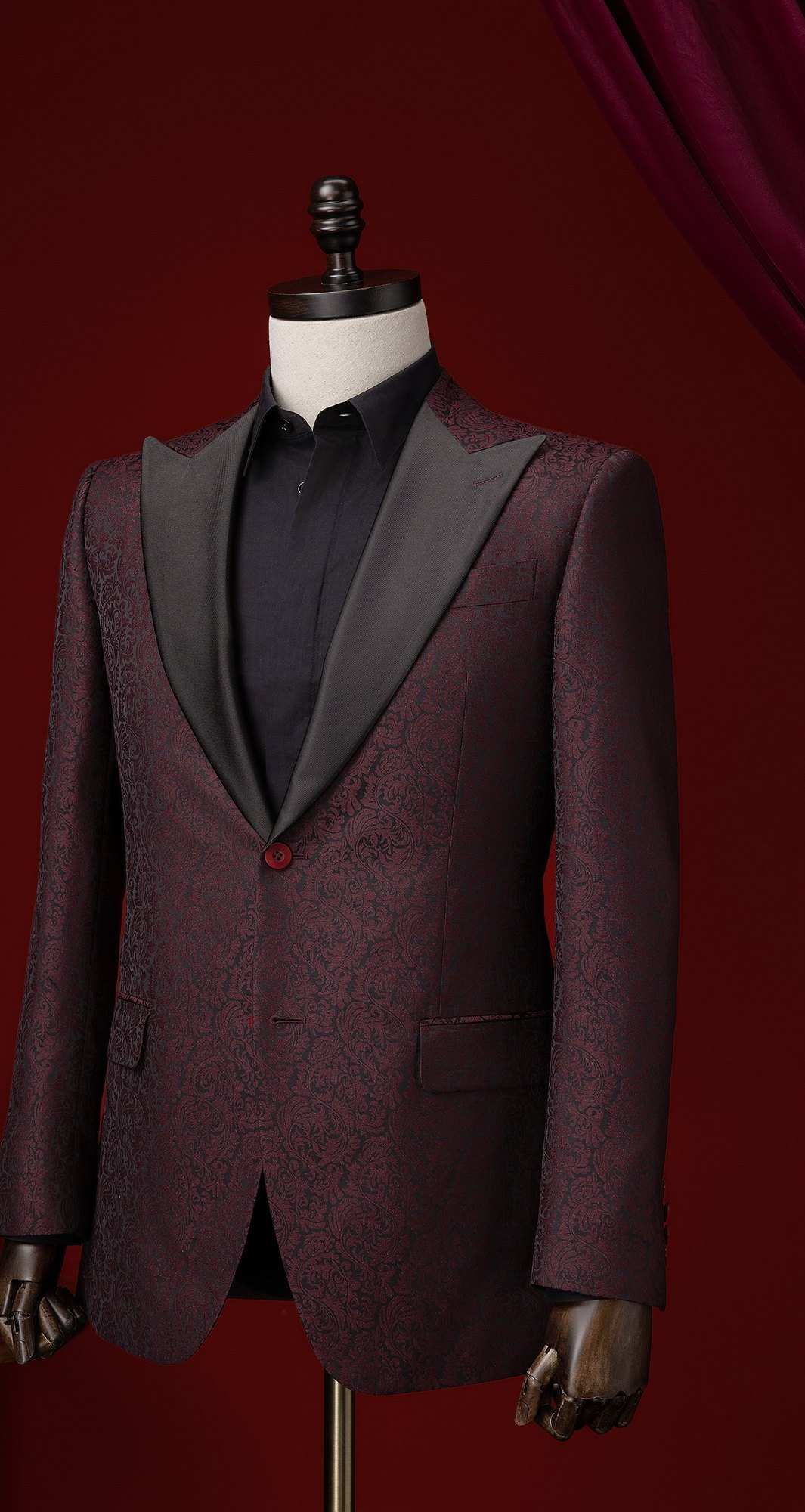
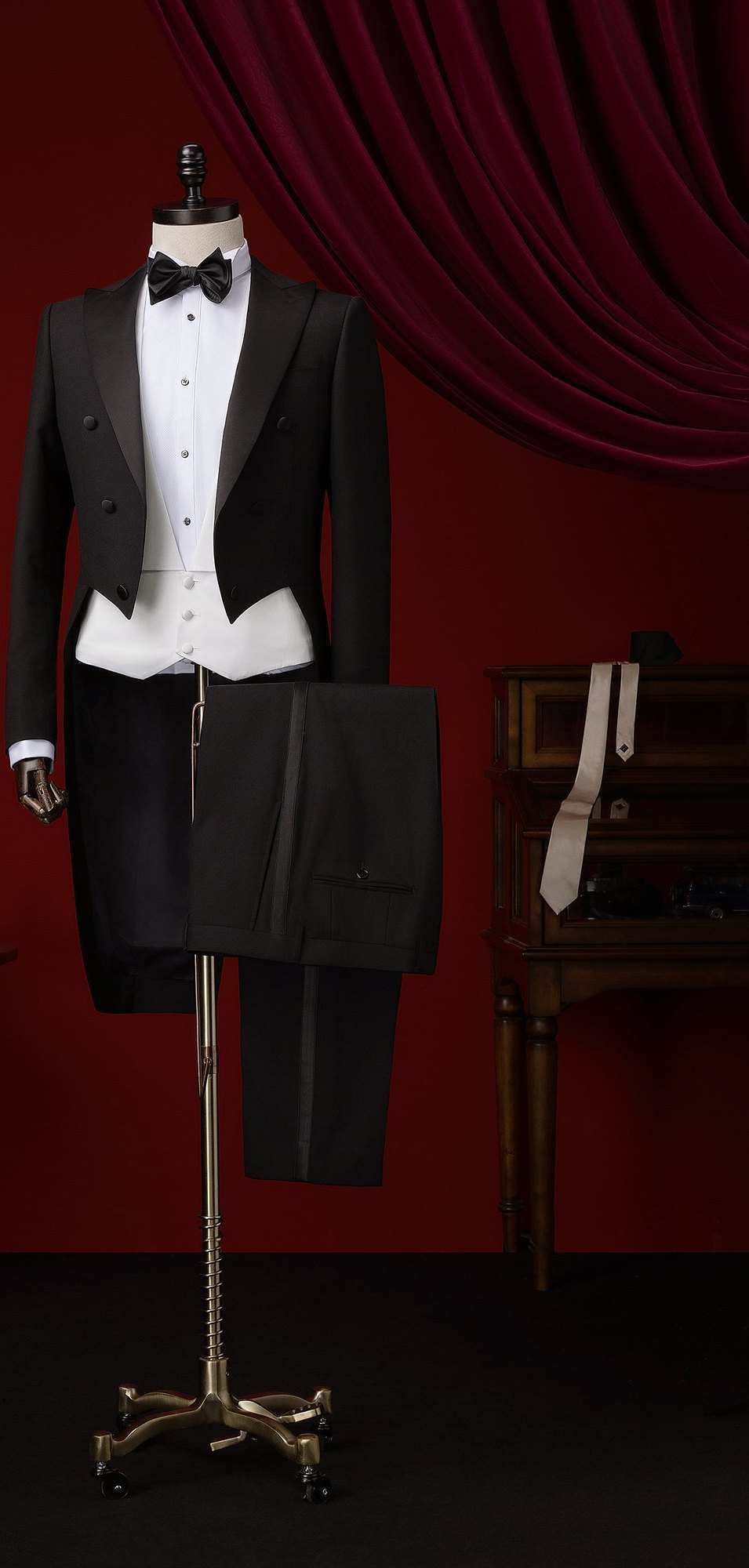
The evenings that matter. This is the signature of our Evening & Ceremony world: a gala dinner, an awards night, a ball, an evening wedding. The night you are seen only once, and remembered long after.
02 · Tuxedos
Which tuxedo should you choose?
The lapel decides a tuxedo’s character; the buttoning, its silhouette. And the school of cut decides its bearing, from the English shoulder to Italian ease: all six schools lend themselves to evening dress.
-
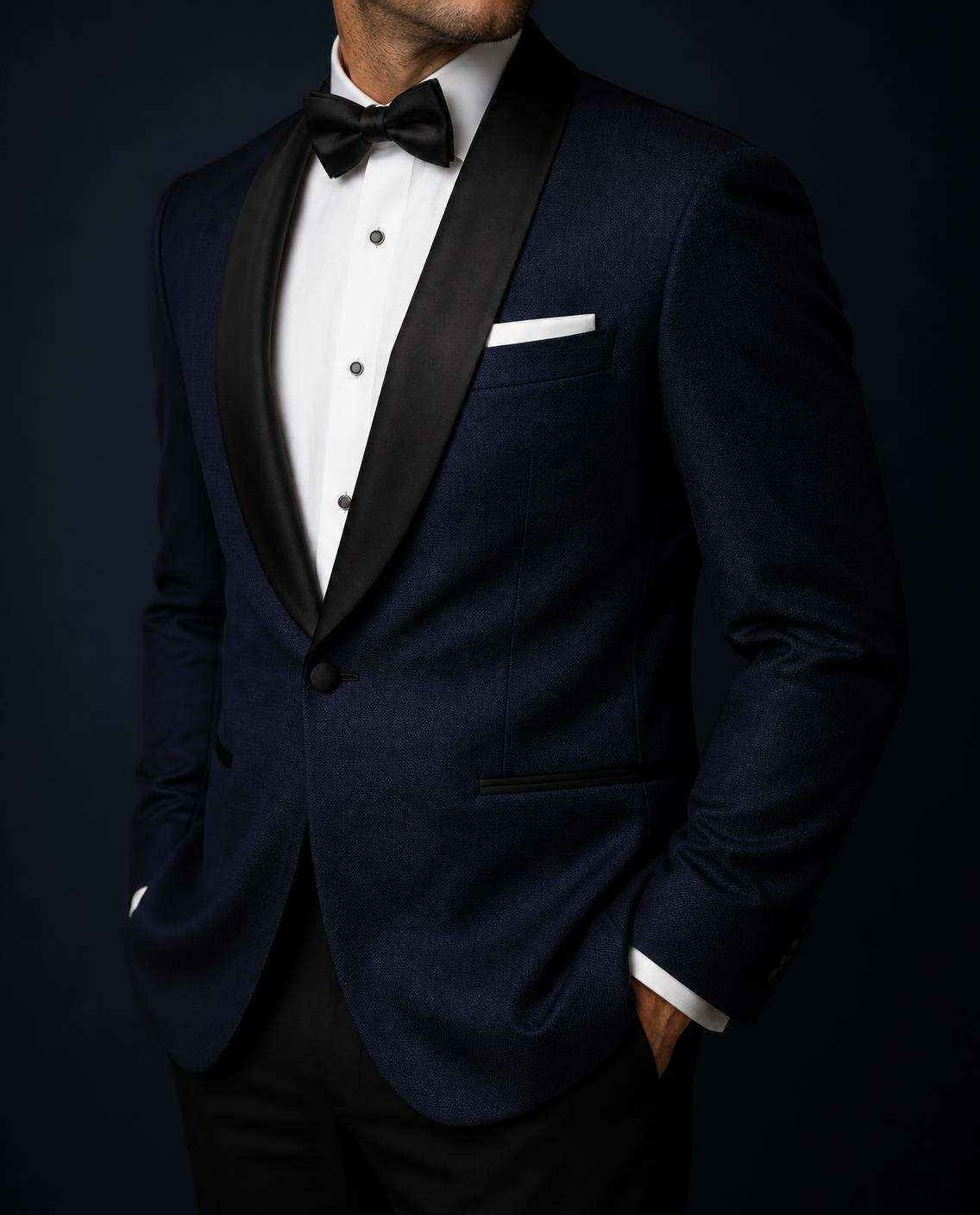
The house style
Midnight blue, blacker than black under evening lights; a fitted cut that keeps its ease through a long evening, satin lapels and a Milanese buttonhole.
The man who wants to be impeccable at the first toast and at ease in the final hour.
-
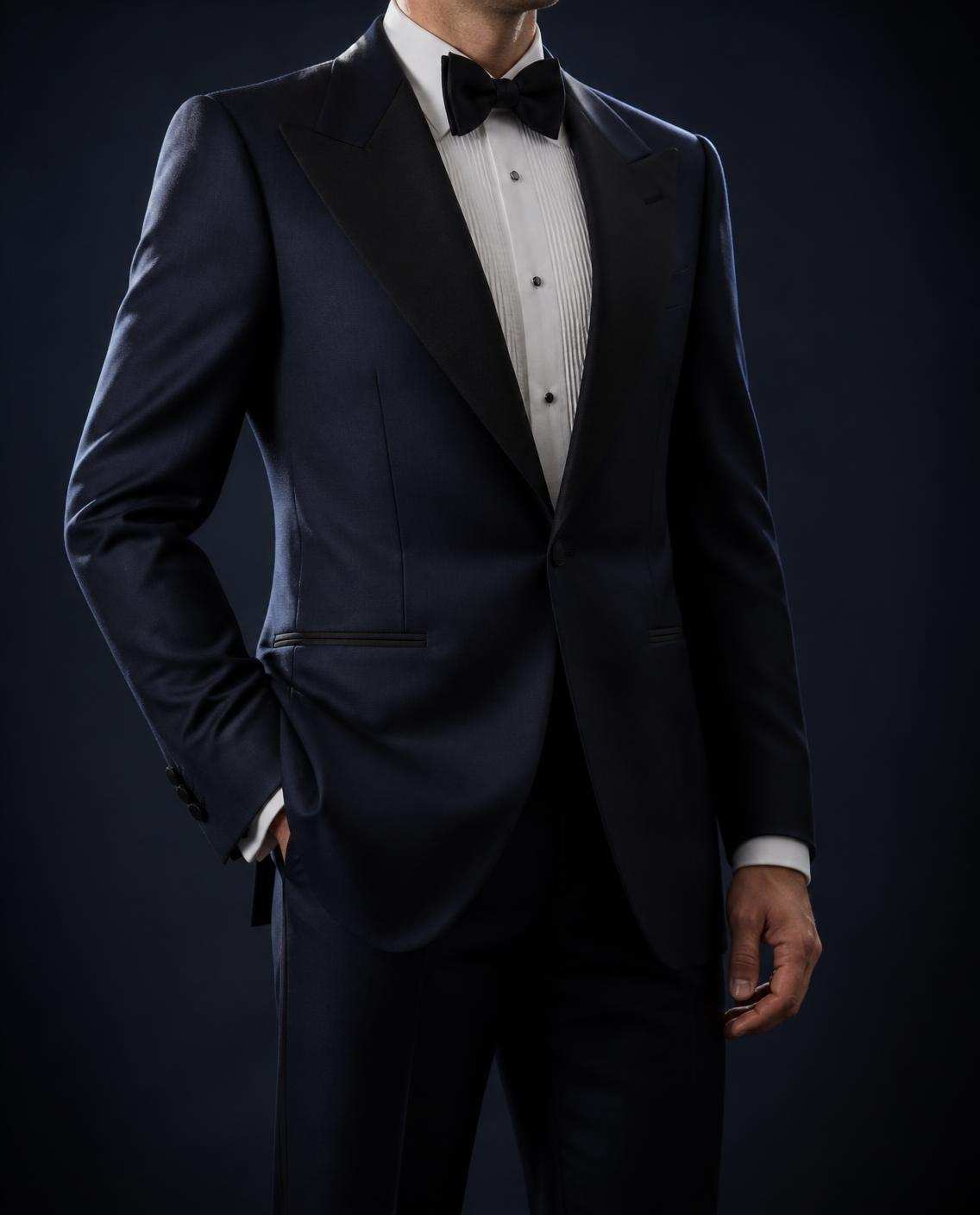
The English
A built-up, high shoulder, a defined waist, one button, peak lapels faced in grosgrain, barathea in midnight blue or black.
The man who hosts and presides: evening authority, through structure.
-
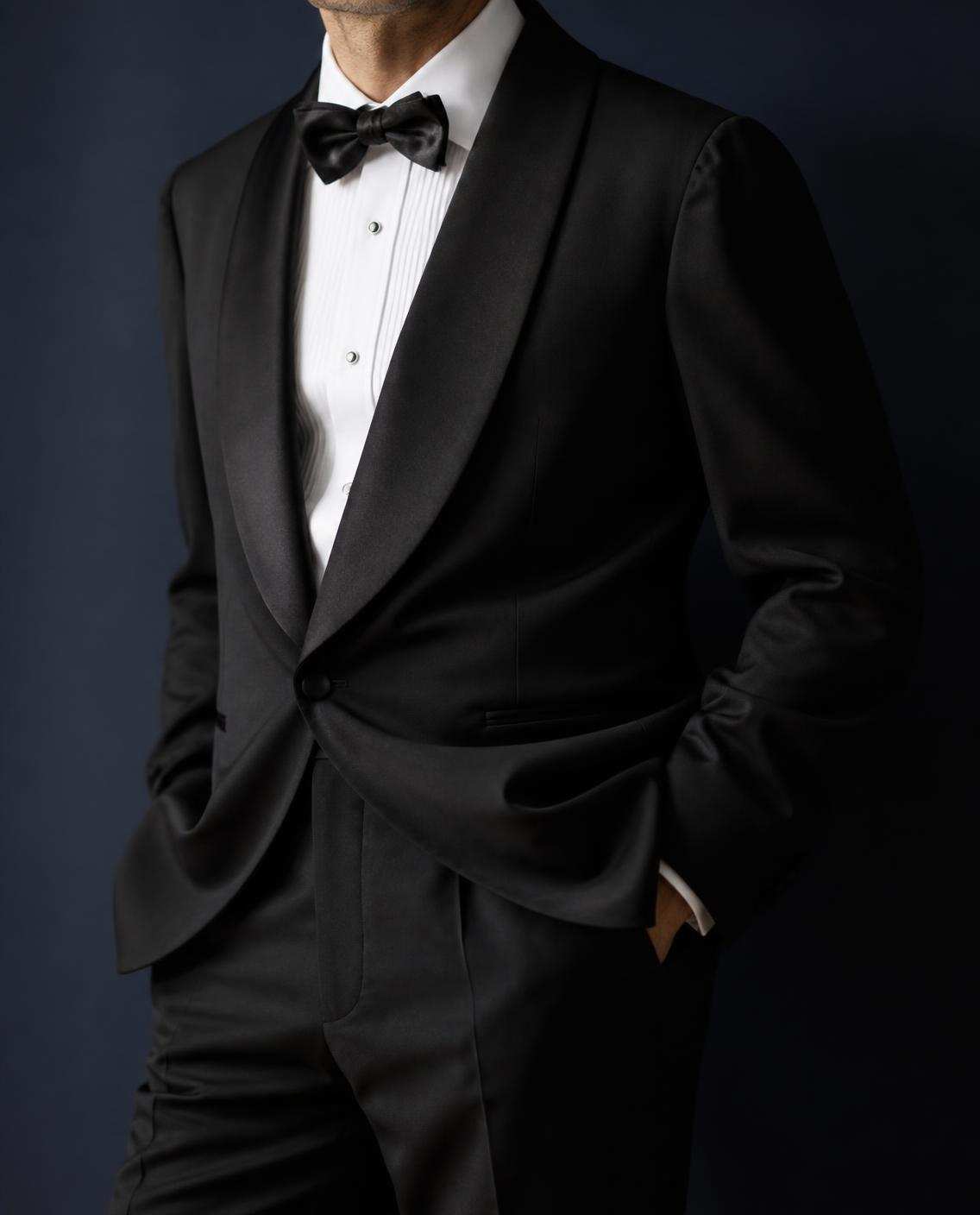
The Italian
A natural shoulder, set like a shirt sleeve, a soft and light jacket, a satin shawl collar, a self-tie bow tie.
The man who wants evening elegance without stiffness, until the last dance.
-
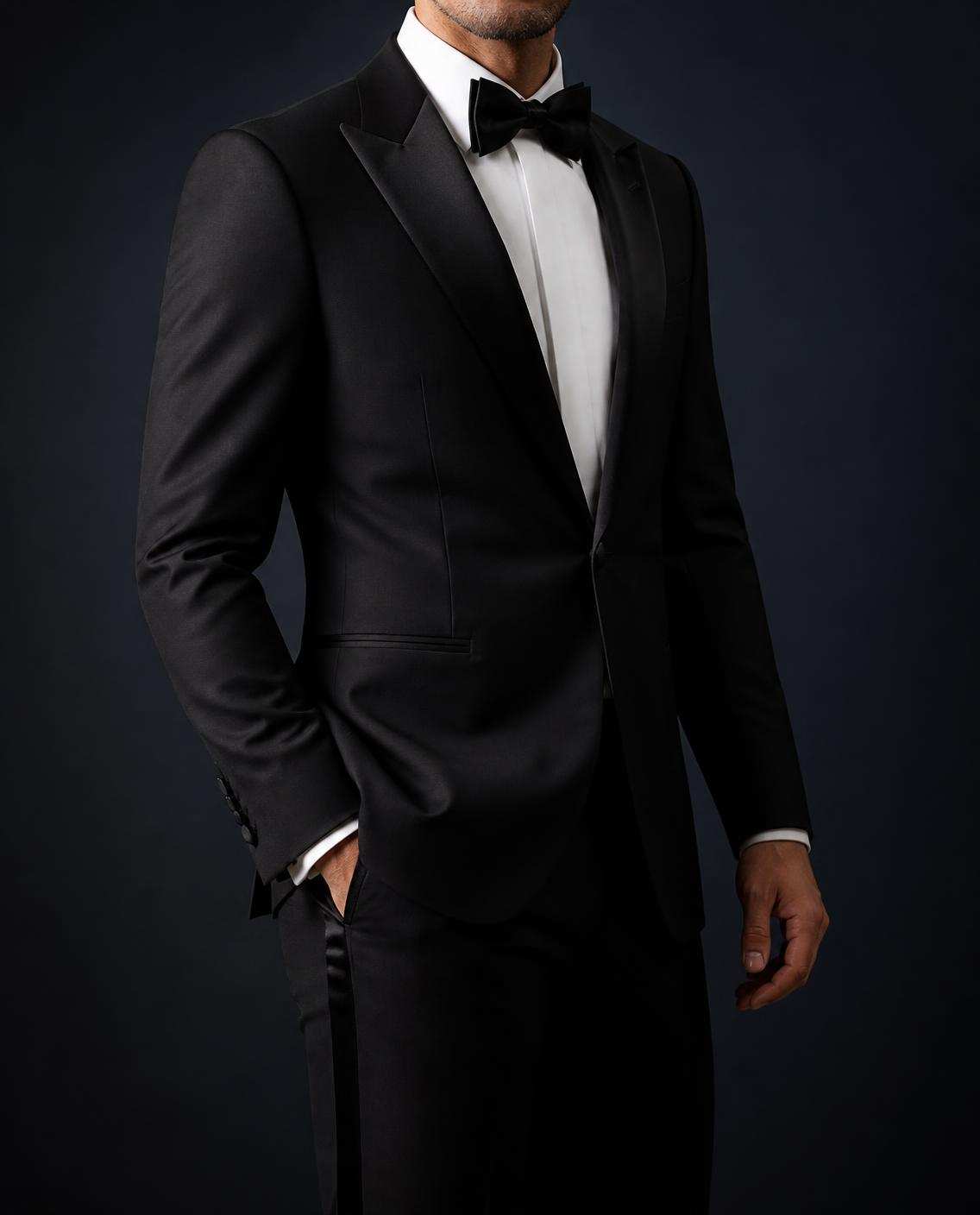
The modern
Cut close to the body, a shorter jacket, slimmer peak lapels, narrow trousers with a satin braid, a slender bow tie.
The new generation, for premieres, launches and the evenings that count.
-
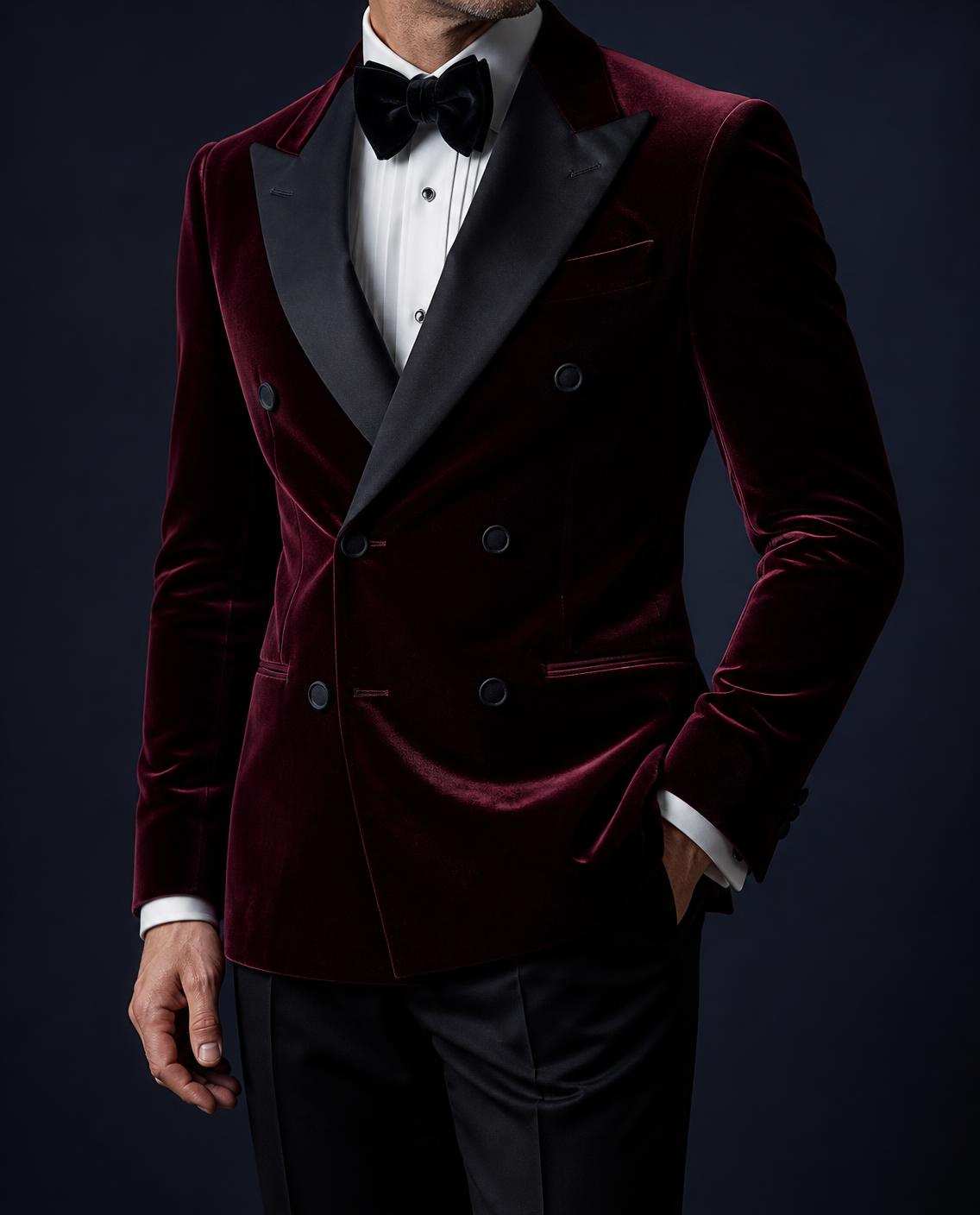
The statement
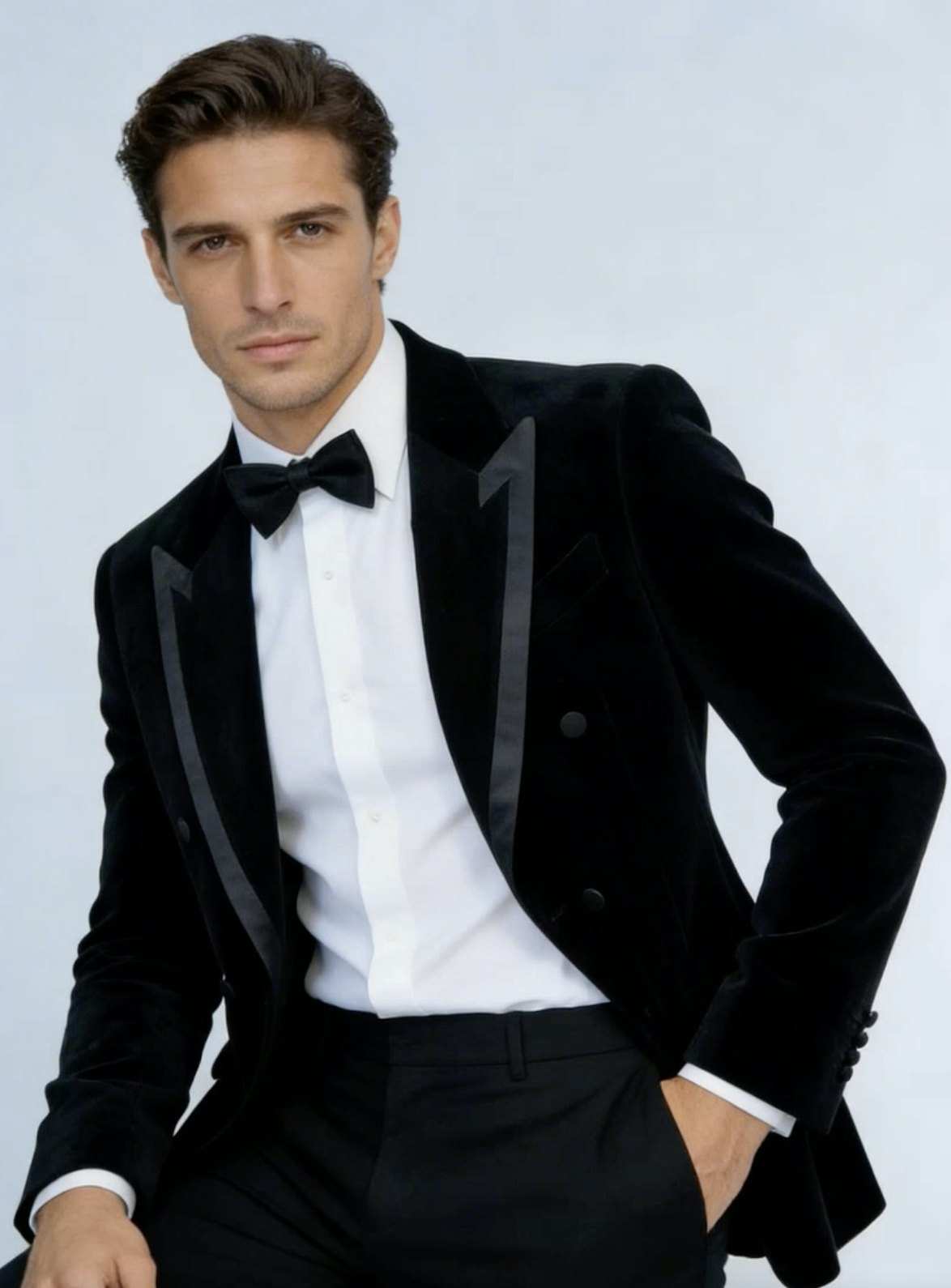
Six-button double-breasted, wide satin peak lapels, velvet or jacquard in deep colours: burgundy, bottle green, midnight blue.
The man who makes an entrance: the tuxedo is noticed as much as he is.
-
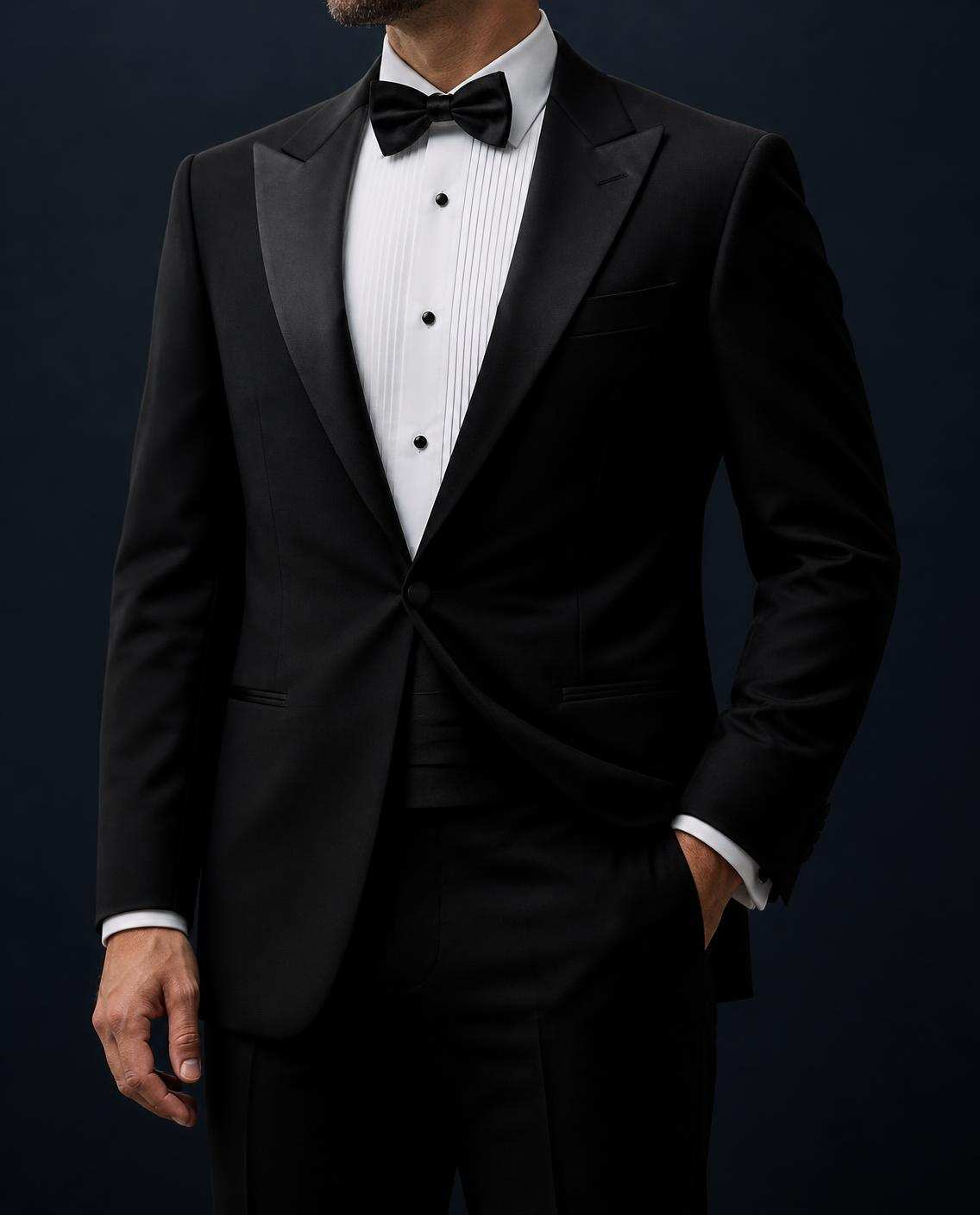
The classic
Single-breasted with one button, satin peak lapels, braided trousers, a silk cummerbund, a bib-front shirt: the rule of black tie, to the letter.
The tuxedo that never dates, from the gala to the evening wedding.
-
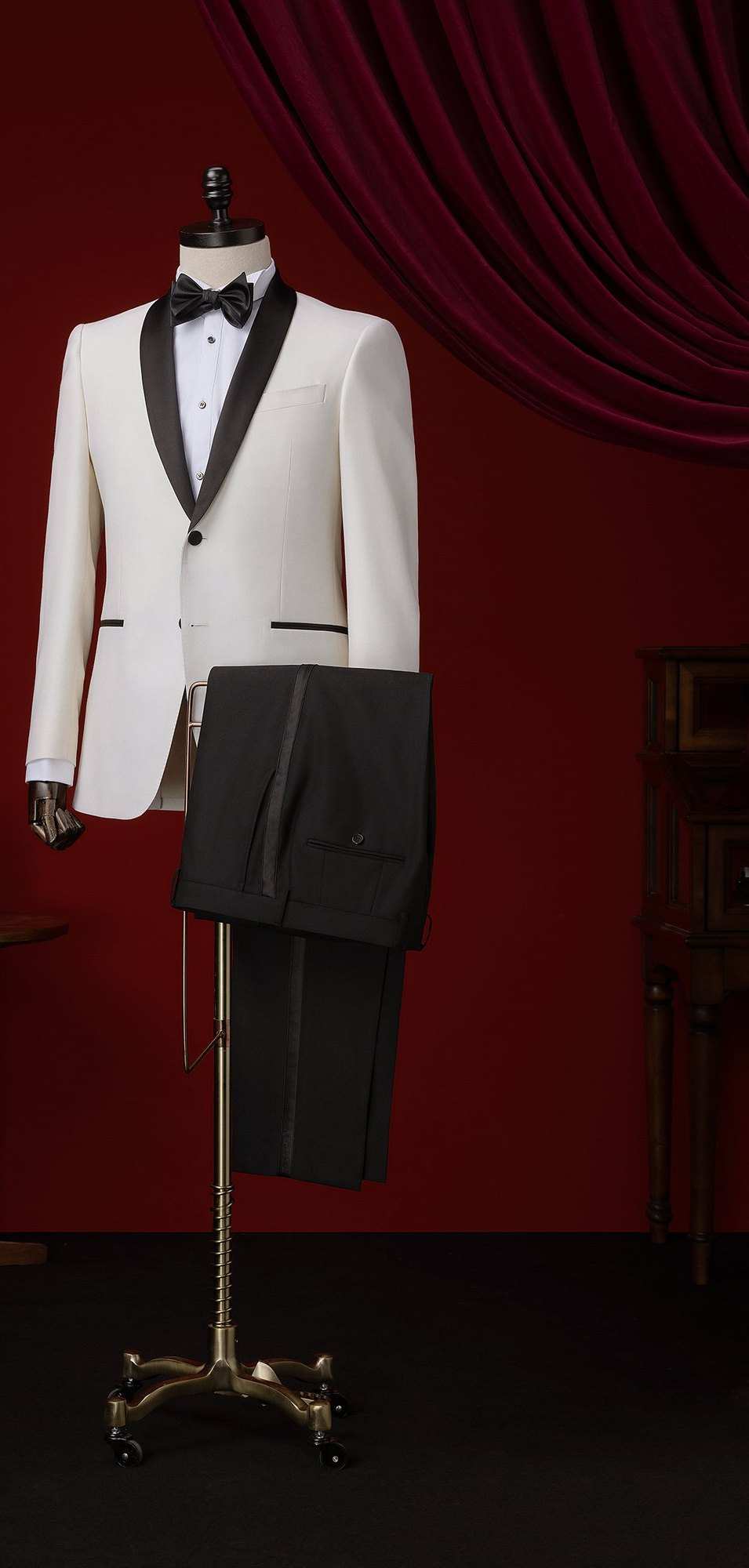
The shawl collar
One unbroken curve, from collar to button, faced in silk. It is the softest and most aristocratic line in the evening wardrobe: the line of grand dinners and the smoking rooms of another age.
-
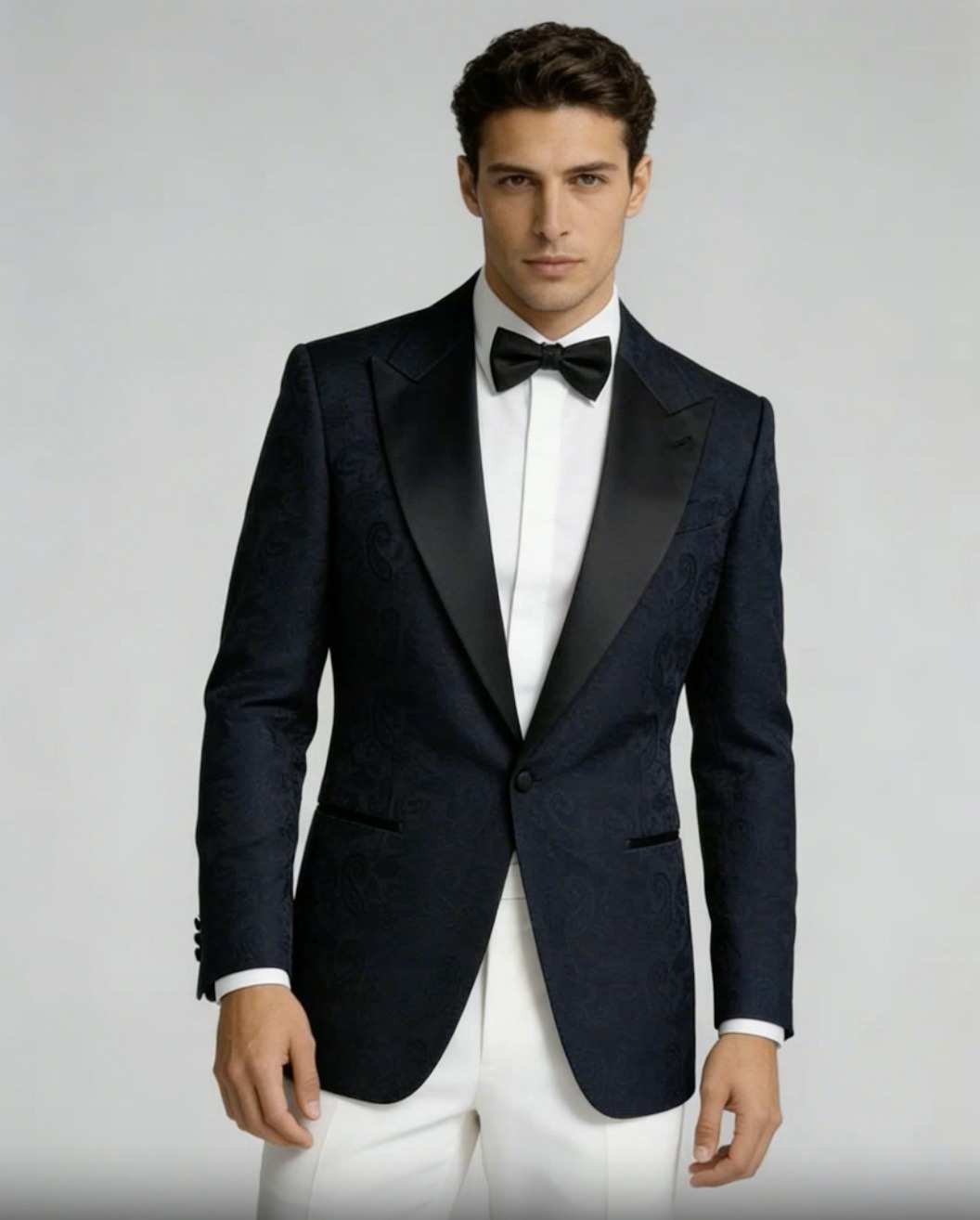
The peak lapel
Bolder, it broadens the shoulders and draws in the waist. On a single-breasted, one-button tuxedo, the peak lapel lends an air of command.
-
The double-breasted tuxedo
A double row of buttons, peak lapels, the jacket worn closed: the most structured silhouette, for the most formal evenings. It needs neither waistcoat nor cummerbund.
-
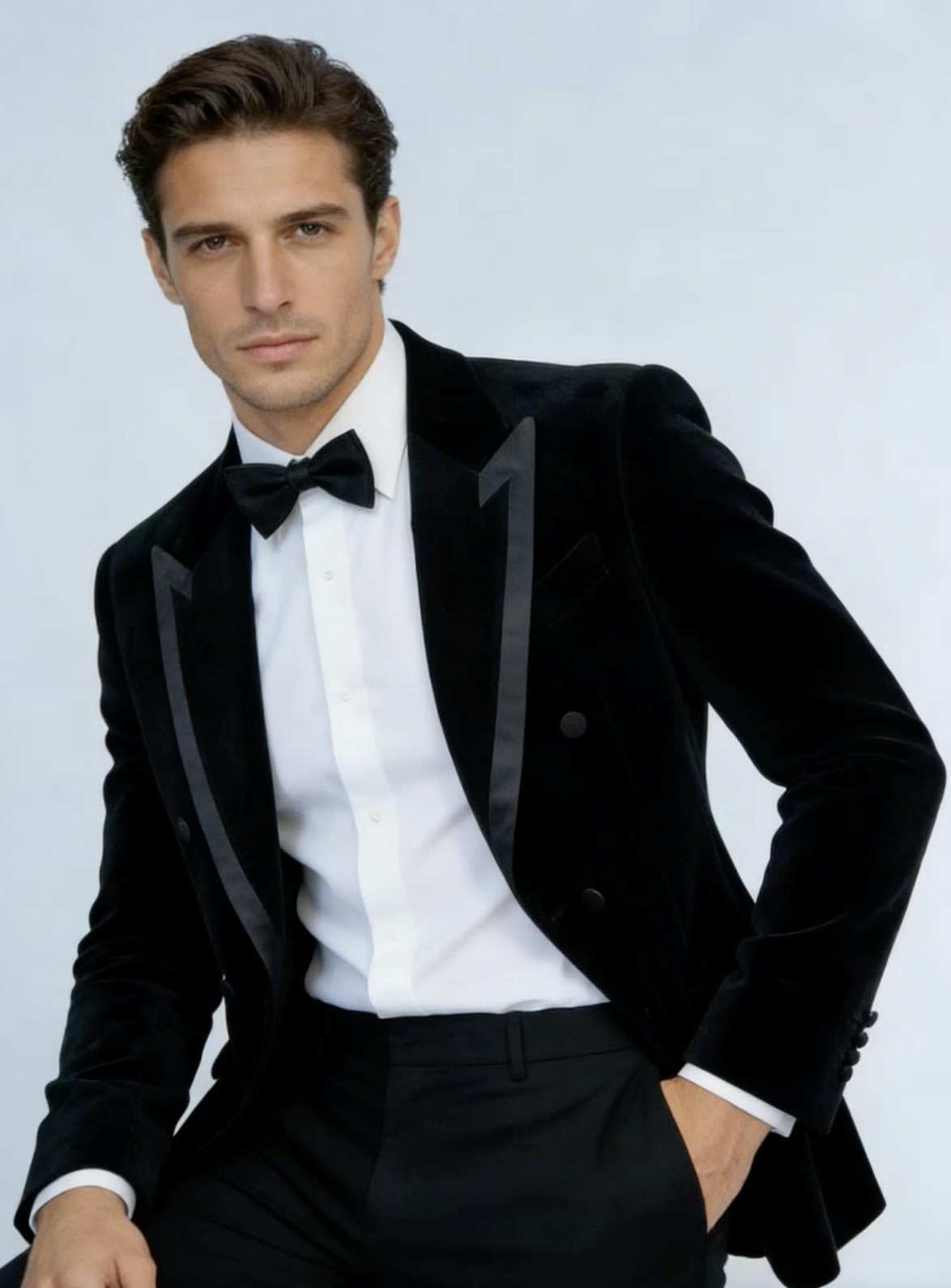
The velvet jacket
For winter dinners, the theatre or the opera, the shawl-collared velvet jacket is worn with tuxedo trousers, in midnight blue, black, burgundy or deep green: velvet catches the light with every movement. In the warmer months, the ivory evening jacket takes over, for a summer wedding, a cruise or a gala on a terrace.
03 · Tuxedos
Black tie, white tie: what to wear, and when?
The invitation sets the code; we help you read it.
| Code | Dress | Occasions |
|---|---|---|
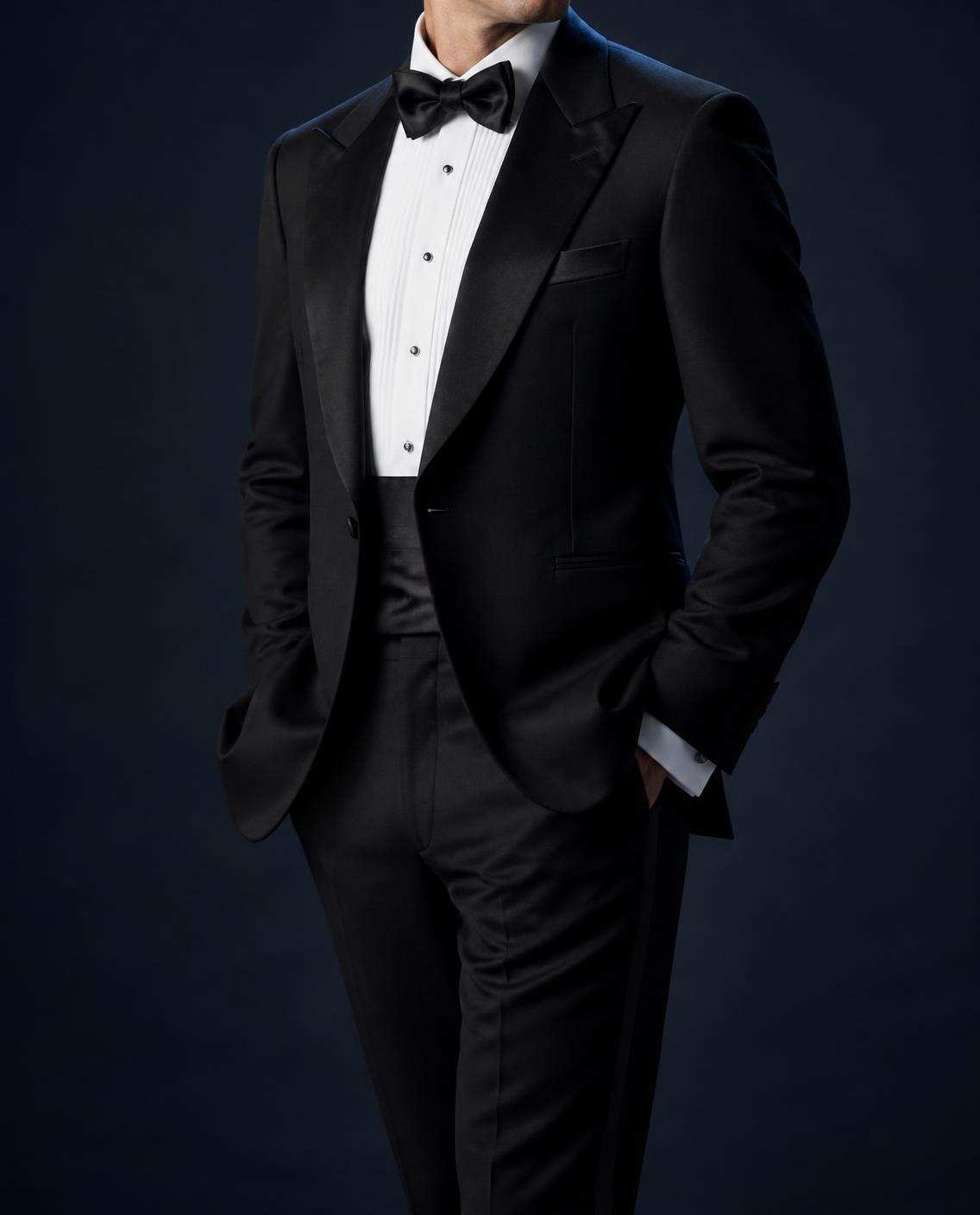 | Tuxedo, evening shirt, black bow tie, waistcoat or cummerbund | Galas, formal dinners, premieres, evening weddings |
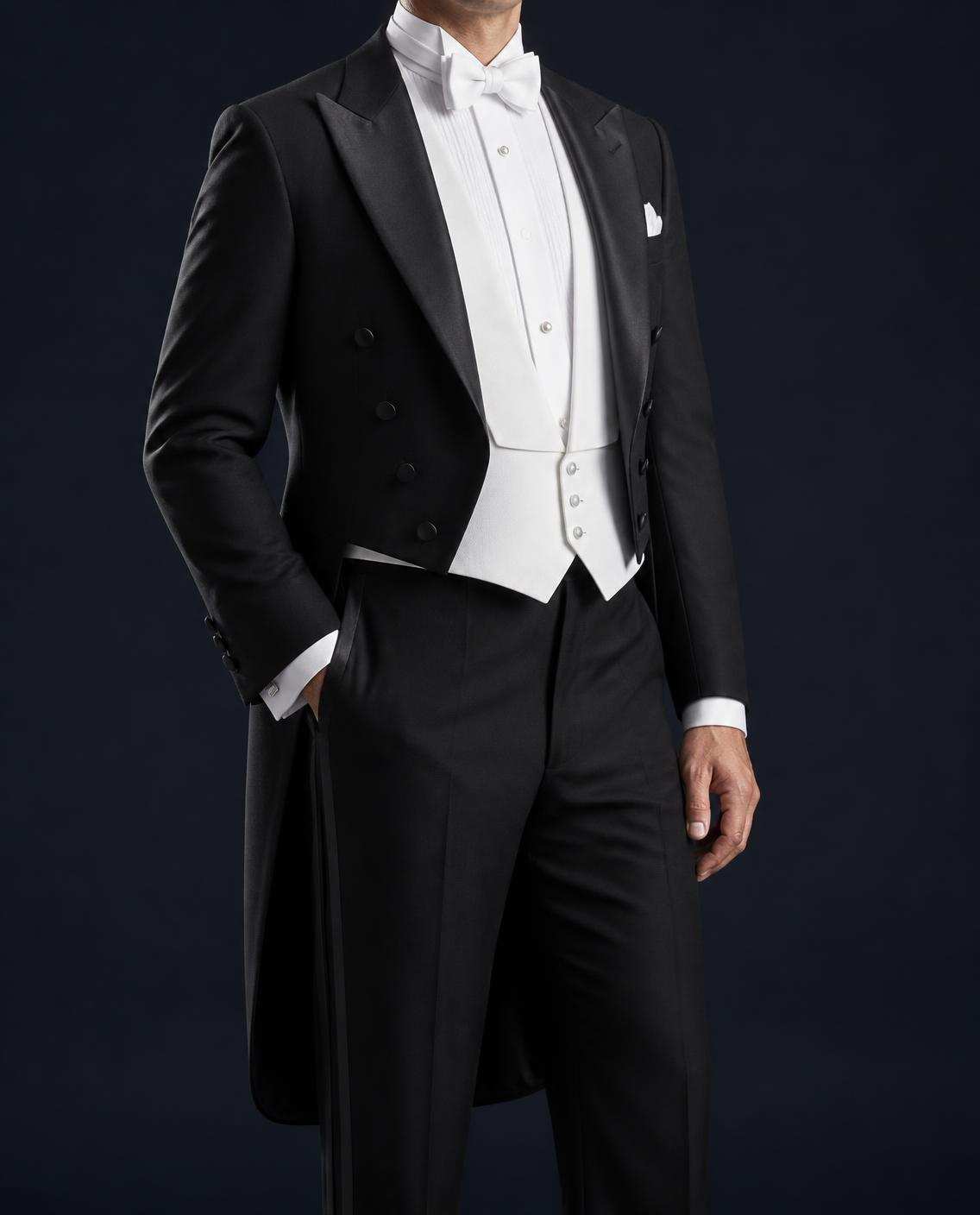 | Tailcoat, white waistcoat and bow tie, bib-front shirt | Balls, official dinners, gala nights at the opera |
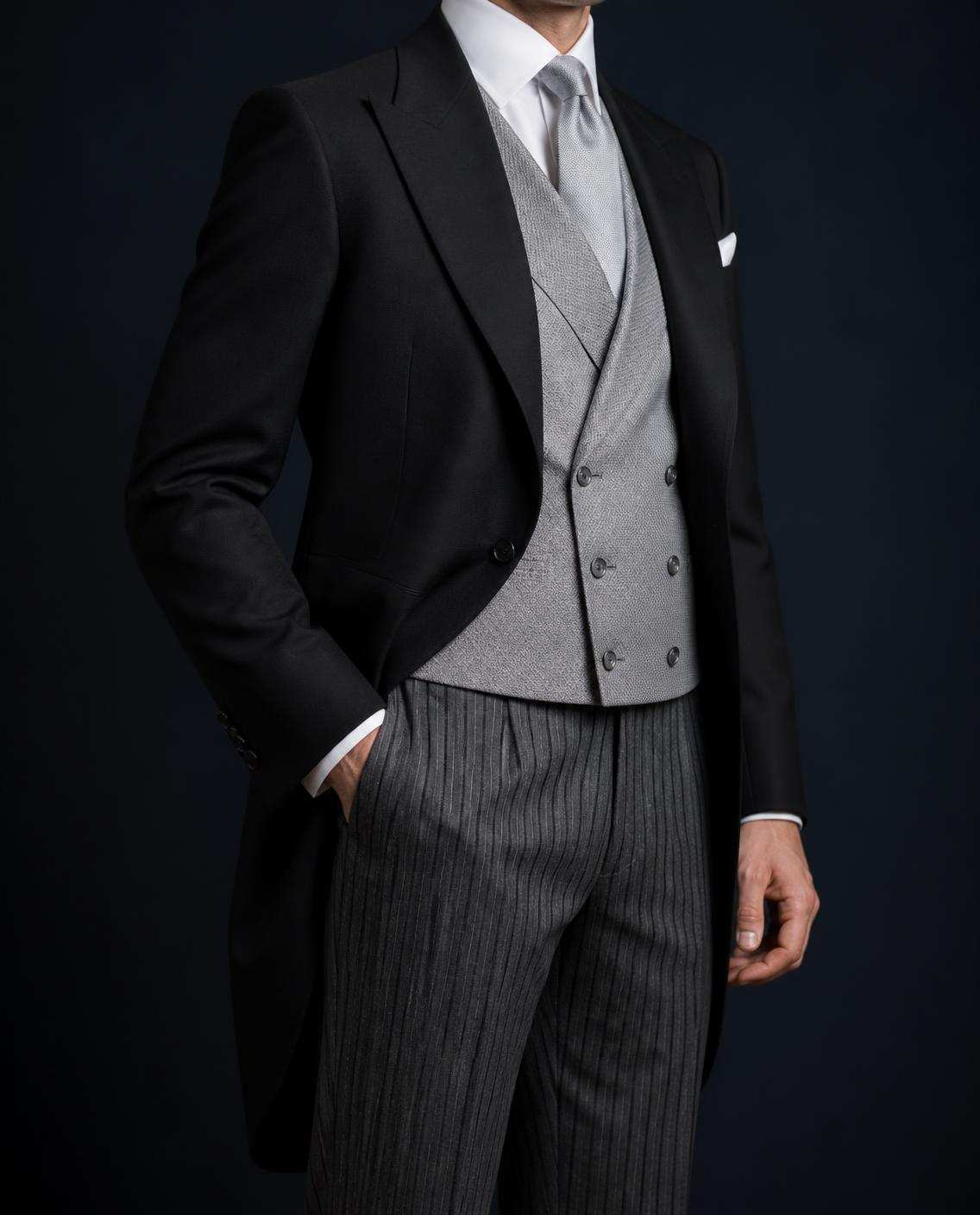 | Morning coat, waistcoat, striped trousers, tie or cravat | Daytime weddings and ceremonies, race meetings |
The tailcoat
The most formal evening dress of all: a jacket cut short at the front, long tails behind, silk-faced lapels, trousers with a double braid. Worn open, it demands an exact cut.
The morning coat
Formal day dress, in grey or black, with rounded tails, worn with a waistcoat and striped trousers. It is what the groom wears to a morning wedding; on our bespoke wedding suit page, we coordinate it across the whole wedding party.
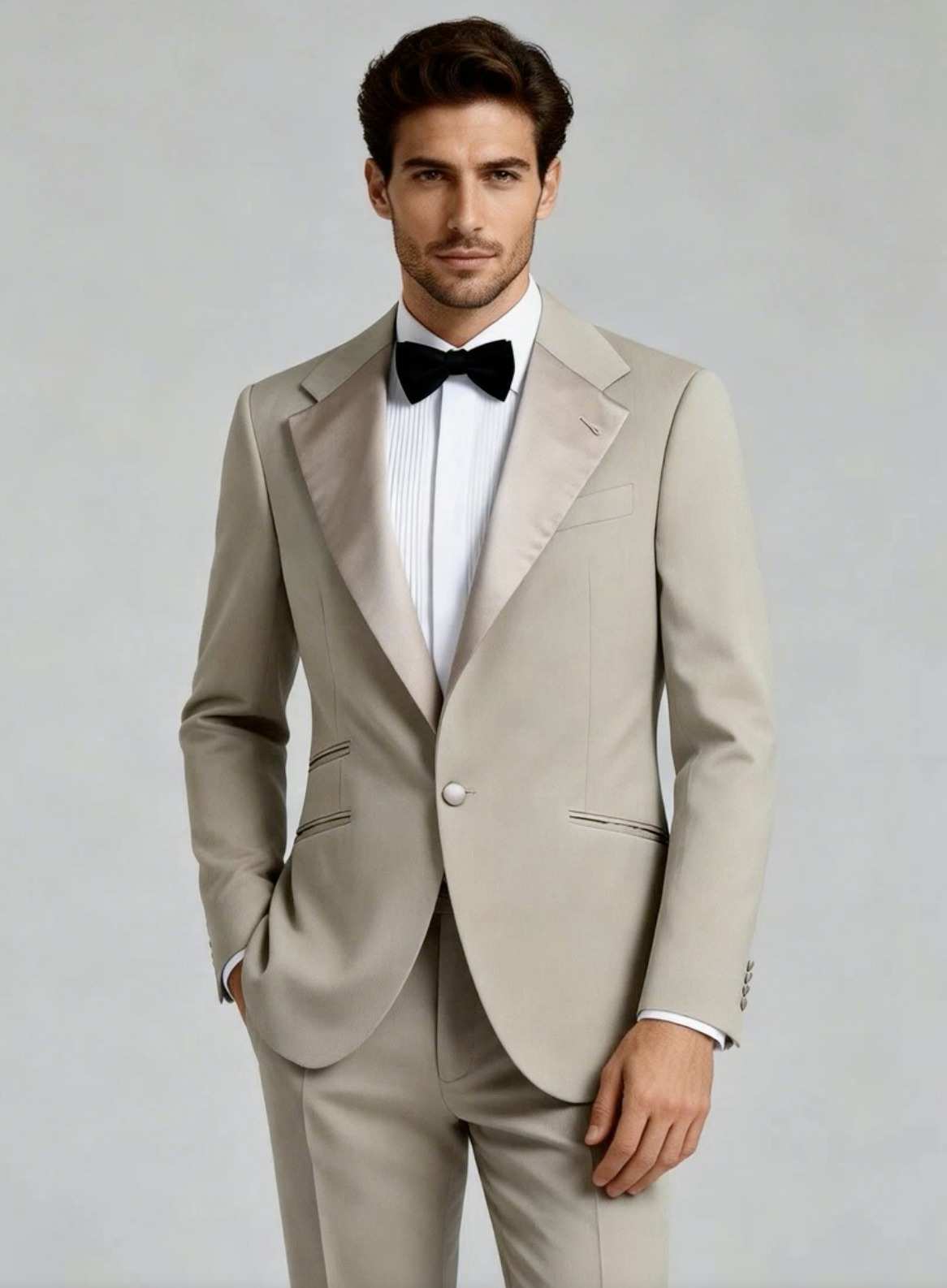
04 · Tuxedos
Which cloth for a luxury tuxedo?
A dense, matt wool, grain de poudre or barathea, for the tuxedo you keep for years: it holds a crease and drinks in the light. A wool and mohair blend for summer evenings and warm rooms: it breathes, resists creasing and catches the light without shining. Velvet for the winter jacket; silk for the lapels.
Our swatch books bring together the houses that have dressed the evening for generations: Loro Piana, Ermenegildo Zegna, Holland & Sherry, Dormeuil, Vitale Barberis Canonico. Under evening light, midnight blue often looks deeper than black; we check it together, cloth in hand. To prepare that choice, explore our cloths and their four ranges.
05 · Tuxedos
Which details set a tuxedo apart?
Every detail is decided with you, on your avatar, before the first cut.
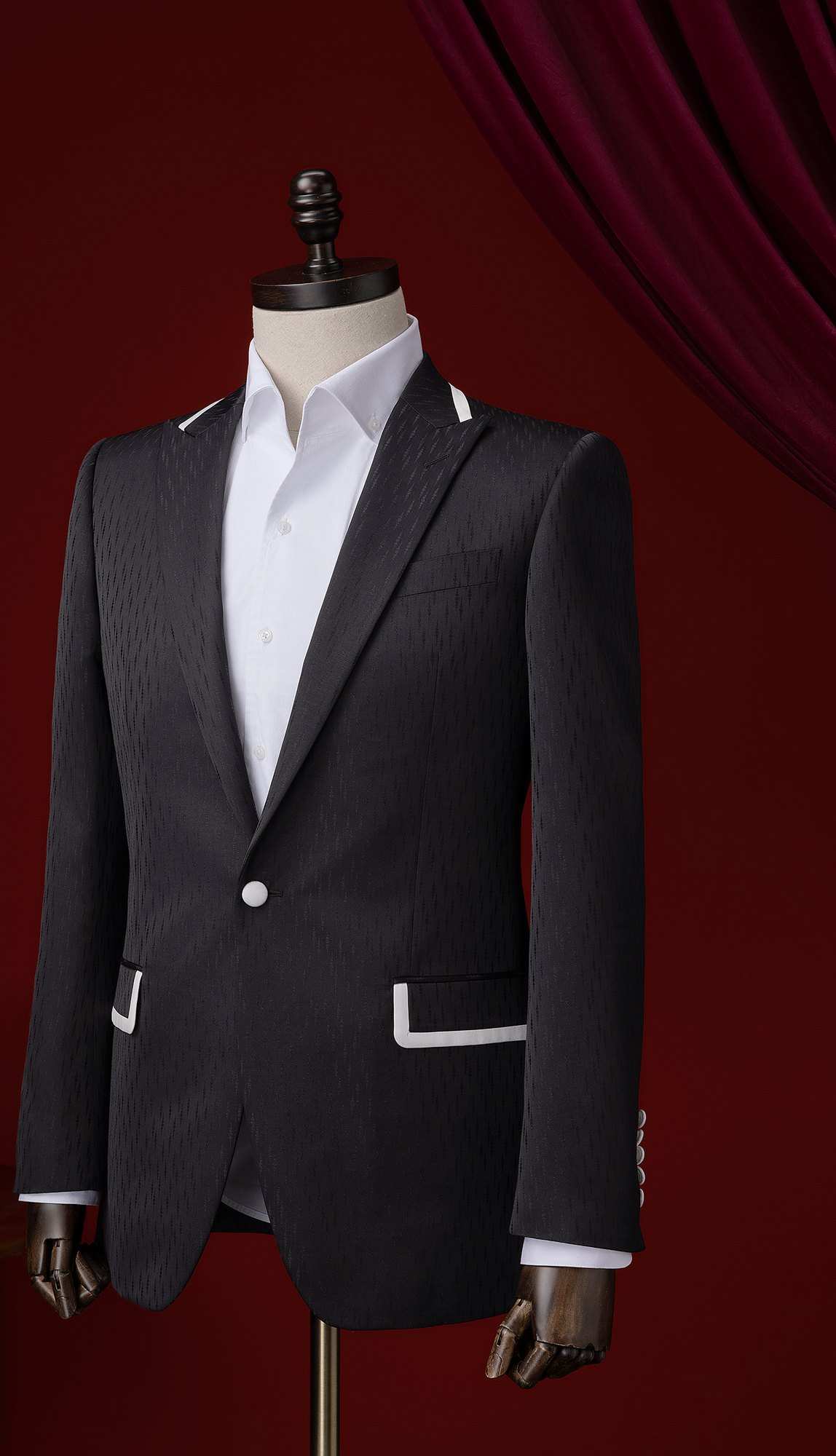
A white edging traces the peak of the lapel and draws the line of the shoulders. Subtle or bold, the contrast comes in the colour of your choice, from the Découverte collection upwards.
From the Premium collection upwards, the collar and shoulders are set by hand: the lapel rolls softly and the jacket follows every movement of the evening.
One button, white like the edging, fastens the jacket at the waist. It lengthens the silhouette and lets the dress shirt speak, from the collar to the bib.
White flaps and piping frame the pockets like a stroke of ink. On a dinner suit, each contrasting finish is composed in the salon, from tone on tone to black and white.
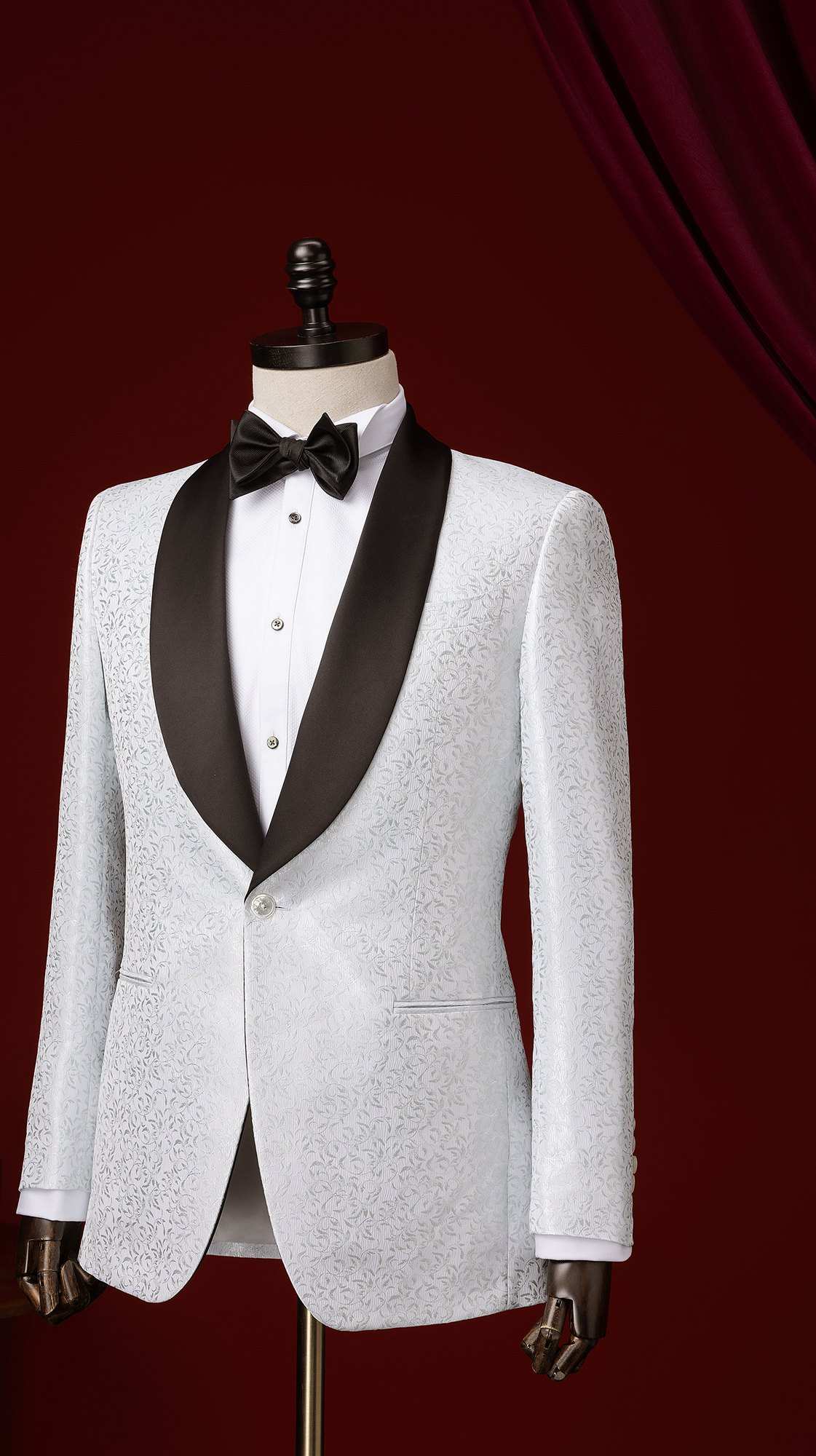
A finely ribbed black jacquard that gives up its pattern only in the light. Velvet, satin, ivory or midnight-blue jacquard: the cloth sets the tone of the evening.
Four cascading white buttons answer the waist button. Sleeve buttons, threads and buttonholes are matched to your taste, in the colour of your choice, from the Découverte collection upwards.
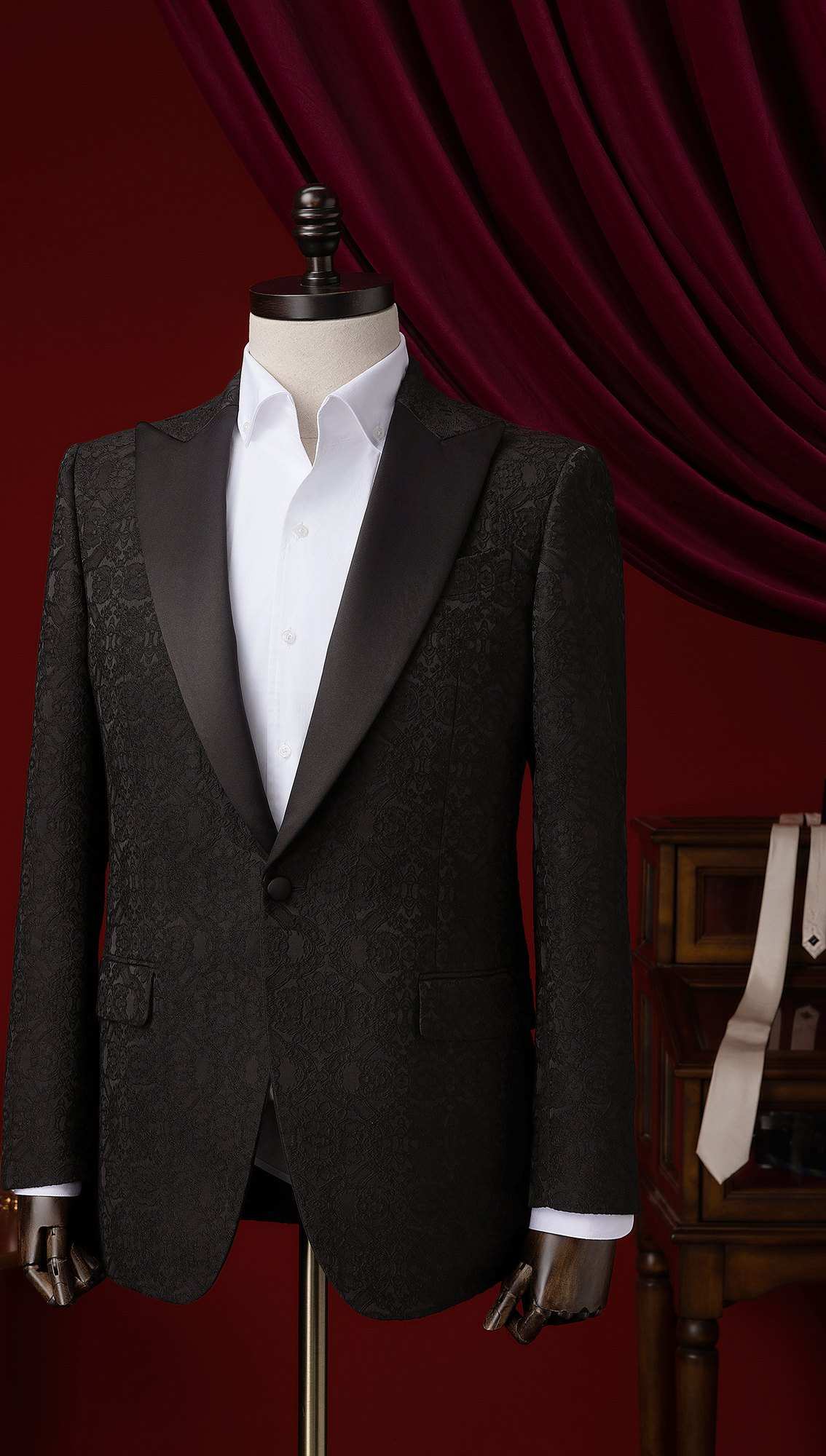
Faced in satin, the peak of the lapel catches the light with every movement. Satin, grosgrain or the suit's own cloth: the facing of the collar is chosen in the salon.
From the Premium collection upwards, the collar and shoulders are set by hand: the collar hugs the nape of the neck and the lapel rolls naturally, never breaking.
Beneath the dinner jacket, a crisp, structured shirt collar. Height, spread and point length are drawn in the salon, to suit your face and the bow tie you choose.
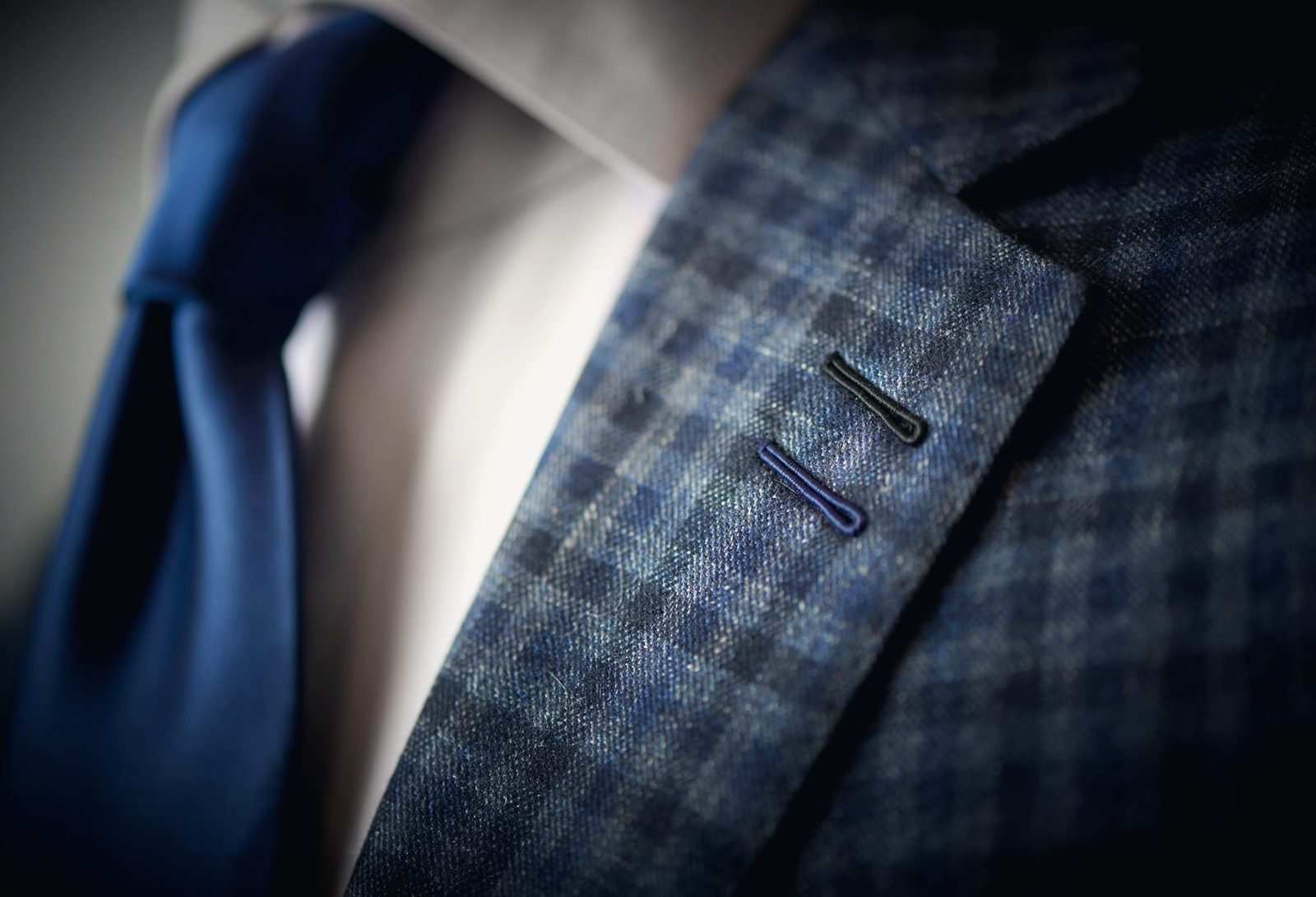
A Milanese buttonhole can be embroidered on the lapel, ready to take a flower. The house signature, it comes with every collection, in the colour of your choice.
One button, matched to the satin of the lapel, fastens the jacket at the waist and carries the line of the collar down to the lowest point of the silhouette.
A black jacquard with tone-on-tone florals, revealed by the slightest movement. A cloth for great occasions, chosen from the swatch books of the great cloth houses.
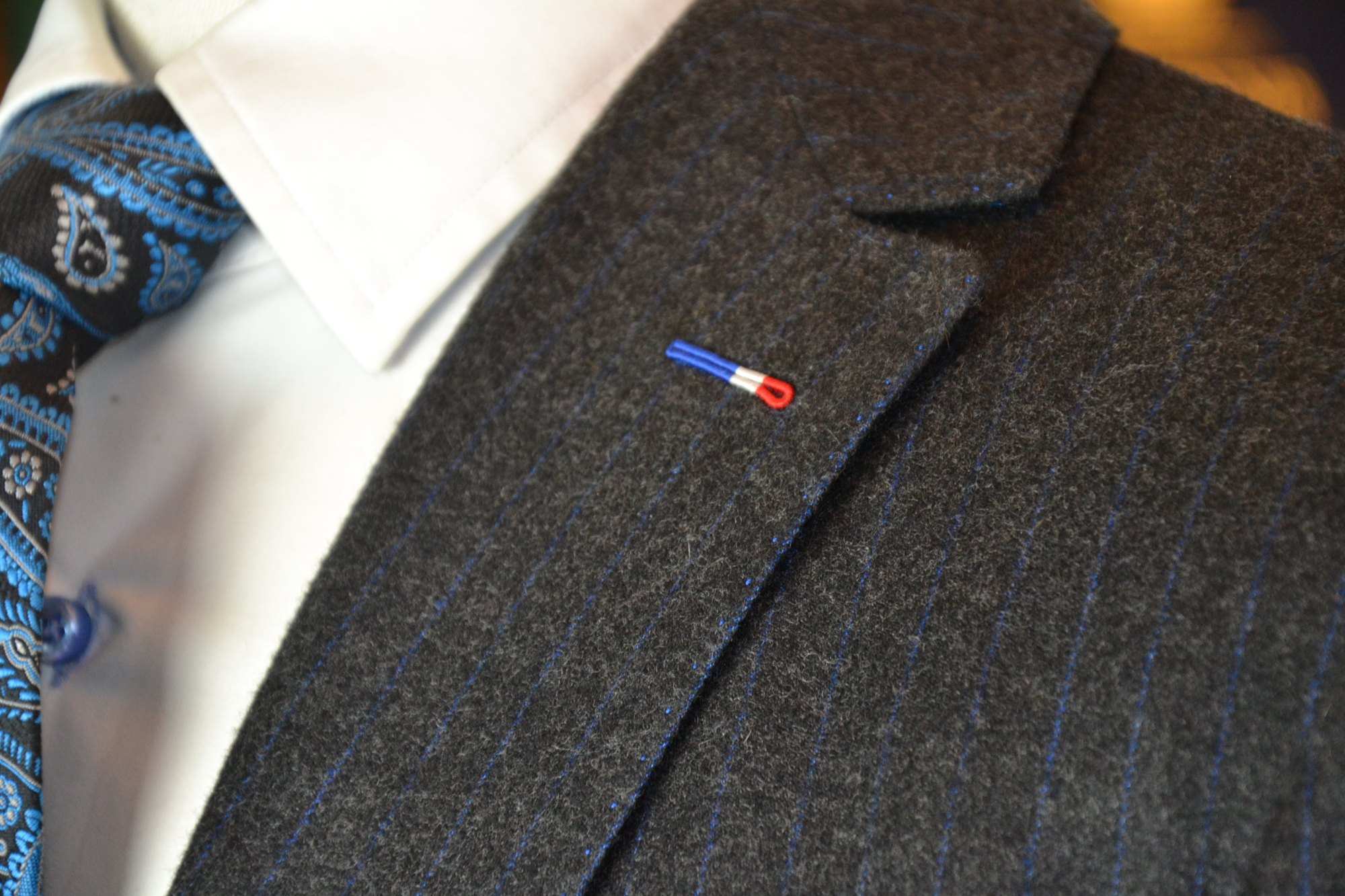
Embroidered in relief over a cord, the Milanese buttonhole is the house signature, found in every collection. Here in blue, white and red, on a charcoal flannel.
Along the lapel, small blue stitches echo the stripe of the cloth. From the Premium collection upwards, this pick stitching can be done by hand, depending on the collection.
From the Premium collection upwards, the collar and shoulders are set by hand: the lapel rolls naturally and the jacket hugs the nape of the neck.
The blue of the fine stripe returns in the buttonhole and in the pick stitching. Matching the colours, from thread to cloth, is possible from the Découverte collection upwards.
Beneath the jacket, a bespoke shirt with a crisp, structured white collar. Height, spread, point length: each collar is drawn in the salon, to suit your face.
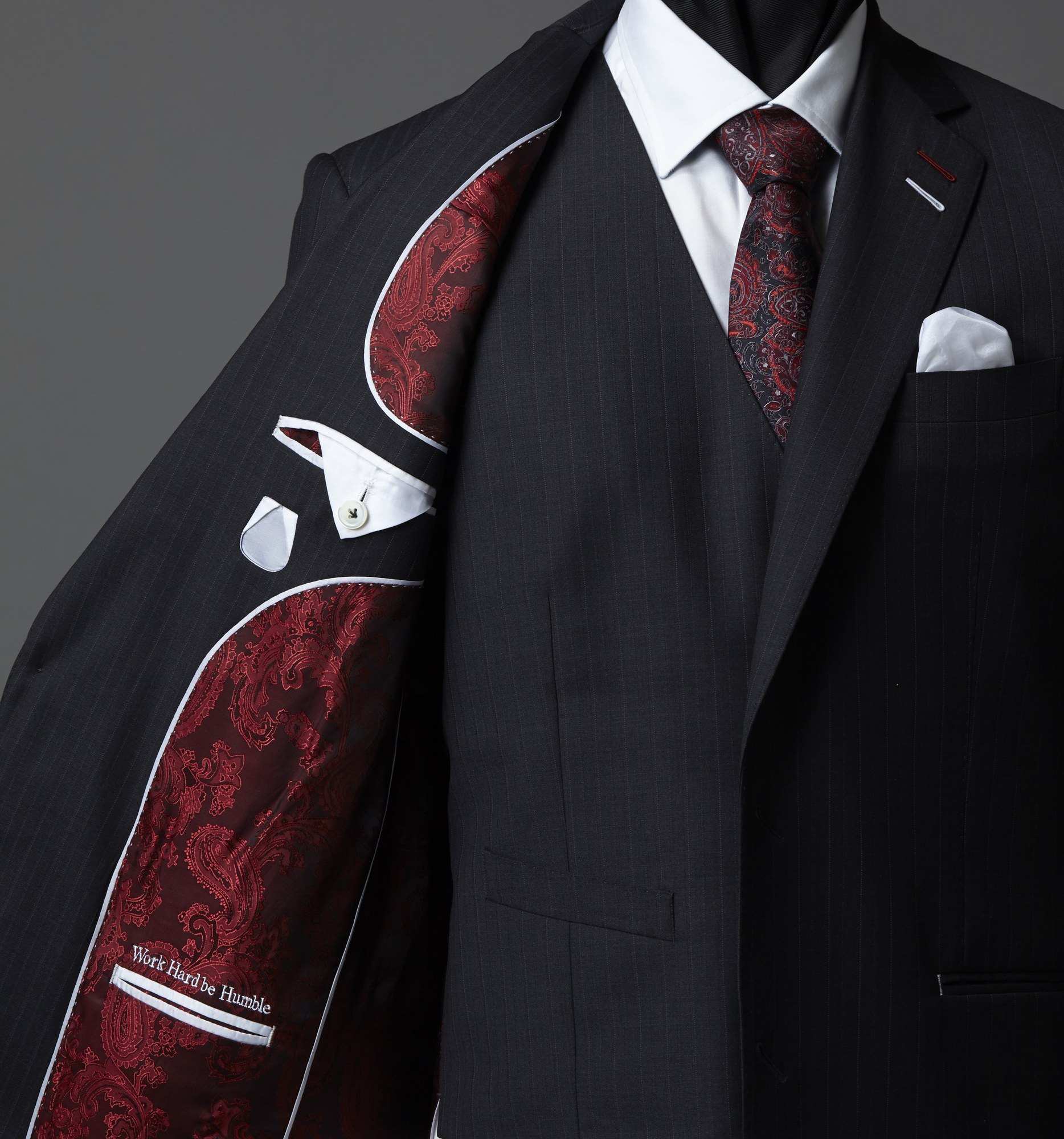
A lapel buttonhole embroidered in a burgundy matched to the lining. Coloured buttonholes and colour matching are available from the Découverte collection upwards: a detail that signs the piece without shouting it.
From the Premium collection upwards, the collar and shoulders are set by hand: the jacket hugs the nape of the neck, moves with you and falls with greater ease.
The inside pocket closes with a triangular tab and a mother-of-pearl button, beneath white piping. A discreet touch, designed to keep wallet and phone in their place.
A fine white piping outlines the facing and follows every curve of the lining. The contrast shows only when the jacket opens, like a confidence.
Here, a burgundy paisley jacquard. In Bemberg or silk, the lining is chosen from the atelier's swatch books: plain for restraint, patterned for boldness, always matched to the cloth.
A motto, a date, initials: embroidered above the inside pocket, they are for you alone. Here, “Work Hard be Humble”, in white thread on the lining.
Touch a gold point to look closer.
- The silk lapelssatin for sheen, grosgrain for matt depth, matched by buttons covered in the same silk.
- The Milanese buttonholeour signature, across every collection; on the lapel, it holds a white carnation or a pin. Tone on tone, or in colour, to surprise.
- The pocketsjetted in silk, without flaps, for a clean line.
- The braided trousersa band of silk along the side seam, a waistband without belt loops, side adjusters or brace buttons.
- The waistcoat or cummerbunda low-cut evening waistcoat, or a pleated cummerbund, its pleats turned upwards.
- The initialsembroidered inside; for a groom, the date of the night that matters.
Inside, a lining of Bemberg or silk, quiet or vivid, that reveals itself only late in the evening, once the jacket is open.
06 · Tuxedos
Which shirt and bow tie with a tuxedo?
Beneath the tuxedo, the evening shirt is cut on your own pattern, like every bespoke shirt: a pleated or marcella bib, a wing or classic collar, double cuffs where mother-of-pearl or onyx cufflinks catch the light. The bow tie is tied by hand, in the silk of the lapels; the white linen pocket square is simply folded. Bow tie, pocket square and cummerbund are chosen with the outfit, from our bespoke accessories, so that they all speak the same language.
07 · Tuxedos
How much does a bespoke tuxedo cost?
A bespoke tuxedo starts at €1,380, cloth included, in the Découverte collection: half-canvas construction, the armhole set by hand, a Milanese buttonhole and every style option. In the Mesure collection it is fully canvassed; from Premium, the collar and shoulders are set by hand; at the summit, the Sartoriale collection, crafted in Italy and fitted in Paris, brings full bespoke. The levels and their prices are set out in the pyramid of suit collections. Waistcoat, cummerbund and evening shirt are added to the outfit, and the whole is priced with you before the cloth is cut.
08 · Tuxedos
How far ahead should you order your tuxedo?
Three to six weeks are enough; best of all, come as soon as the invitation arrives.
- The occasioninvitation in hand, at the atelier or by video call: the evening, the dress code, the date.
- The measuringan hour at the atelier: every measurement, a pattern unique to you, the cloth and the details.
- The compositionyour tuxedo takes shape on your avatar; you see it before you approve it.
- The fittingstwo to three, in Paris; a fitting toile, should you wish.
- The handoverthe final fitting at the atelier, pin in hand, with time to spare before your evening.
Frequently asked questions
What we are asked
How much does a bespoke tuxedo cost in Paris?
A bespoke tuxedo starts at €1,380, cloth included, in the Découverte collection. From there, the price follows the pyramid of the house’s collections: full-canvas construction from Mesure, collar and shoulders set by hand from Premium, and full bespoke in the Sartoriale collection. The waistcoat, cummerbund and evening shirt are additional; the final price is set with you at the atelier, cloth in hand.
How long does a bespoke tuxedo take?
Three to six weeks from measuring to delivery, with two to three fittings in Paris. For a gala, a wedding or a ceremony on a fixed date, tell us that date at our first meeting: we plan the fittings around it and keep time in hand for the last adjustments before the evening.
Tuxedo, tailcoat, morning coat: what is the difference?
The tuxedo belongs to the “black tie” code: formal evening dress. The tailcoat, with white waistcoat and white bow tie, belongs to “white tie”, the most formal code of all. The morning coat, worn with a waistcoat and striped trousers, is the formal day dress of weddings and ceremonies. We make all three bespoke.
A black or a midnight-blue tuxedo?
Both are correct. Under evening light, midnight blue often looks deeper than black, which is why connoisseurs prefer it. Black remains the reference, and the safest choice for an invitation that reads “black tie”. We compare the two cloths with you, in the light of the atelier, before deciding.
Can a tuxedo be worn to a wedding?
Yes, whenever the celebration takes place in the evening or the invitation reads “black tie”. The groom may choose it for the evening, and so may his best men, in the same cloth or in a variation. For a daytime ceremony, the morning coat or the three-piece suit is more fitting; we discuss it at our first meeting.
Smoking, tuxedo, dinner suit: what is the difference?
None, except the language: “smoking” is the French word, “tuxedo” the American one, “dinner suit” the British. The codes remain those of black tie: a jacket with silk-faced lapels, trousers with a silk braid, an evening shirt and a bow tie. The tuxedo is also cut for women, with a fitted jacket and braided trousers, on a pattern that bears your name.